Showing posts with label FEFLOW. Show all posts
Showing posts with label FEFLOW. Show all posts
Monday, 16 February 2015
First Workshop on Numerical Geothermal Simulation at TUM
Venue: Technische Universität München, Arcisstr. 21, 80333 München
Date: 8th-9th April 2015
Registration: http://www.feflow.com/fileadmin/FEFLOW/content_training/2015/RegistrationForm_8-04-2015_en.pdf
 This new workshop at the Technische Universität München is aimed at anyone dealing with numerical geothermal simulation in the context of geothermal energy for practical applications or research.
We received an overwhelming response to the call for papers, and the full program for the workshop is available now!
Venue: Technische Universität München, Arcisstr. 21, 80333 München
Date: 8th-9th April 2015
Registration: http://www.feflow.com/fileadmin/FEFLOW/content_training/2015/RegistrationForm_8-04-2015_en.pdf
We received an overwhelming response to the call for papers, and the full program for the workshop is available now!
FEFLOW 2015 - Modelling the World of Groundwater with MIKE by DHI
Date: September 21-25, 2015
Venue: Pentahotel Berlin-Köpenick, Grünauer Straße 1, 12557 Berlin, Germany
Information: http://www.feflow.com/fileadmin/FEFLOW/content_tagung/feflow2015/DE_THEACADEMY_FEFLOW2015_1stcirc.pdf
 Building on the huge success of the previous FEFLOW conferences, FEFLOW 2015 will feature numerous opportunities for business networking, exchanging ideas and improving your modelling skills.
Highlights include:
We hope to meet you for another memorable event in Berlin!
The FEFLOW 2015 Organising Committee
Date: September 21-25, 2015
Venue: Pentahotel Berlin-Köpenick, Grünauer Straße 1, 12557 Berlin, Germany
Information: http://www.feflow.com/fileadmin/FEFLOW/content_tagung/feflow2015/DE_THEACADEMY_FEFLOW2015_1stcirc.pdf
Highlights include:
- keynote presentations of trends and latest ideas in numerical groundwater modelling
- presentations showcasing solutions for challenging problems related to groundwater
- poster session
- product updates and previews on upcoming releases
- opportunities to meet with the FEFLOW staff
- preconference field trip ‘Open-pit lignite mining in Lusatia’
- software demonstrations
- training courses and workshops
We hope to meet you for another memorable event in Berlin!
The FEFLOW 2015 Organising Committee
Thursday, 8 May 2014
Tuesday, 6 May 2014

With our new FEFLOW Essentials package, you can take advantage of FEFLOW’s effective concepts, tools and workflows for your everyday projects at an attractive price.
FEFLOW Essentials provides all FEFLOW functionality for: regional groundwater modeling in 2D and 3D, single-species solute transport with sorption and 1st order reaction, heat transport in groundwater and porous media, and groundwater age, lifetime expectancy and exit probability computation. Read more >>>
Celebrate the launch of FEFLOW Essentials with a FREE training course at the 2014 MIKE by DHI UK Symposium!
Date: 14th May 2014
Venue: Coombe Abbey Hotel, Warwickshire, UK
Learn how to set up a steady state groundwater model from scratch using new functionality in FEFLOW 6.2. Set up a transient flow model; varying the boundary conditions and material parameters. Learn how to add mass transport to the model. Evaluate the model, display results and more…
To sign up please call 01752 691723 or visit www.dhi-uk.info/ugm
Monday, 28 April 2014

Pushing the Boundaries – New Issues and Applications in Groundwater Modelling
Date: 13 May 2014
Event type: Conference
Organised by: Groundwater Modeller’s Forum, Hydrogeological Group
Venue: Birmingham
The UK Groundwater Modellers’ Forum is holding its 12th workshop on new issues and applications in groundwater modelling in the UK. Read more >>>
DHI will be presenting at the above Groundwater Modellers' Forum event on the 13th May 2014. Roberta-Serena Blasone (DHI) will give a talk on 'Coupling groundwater and ecological models (MIKE SHE & ECO Lab)' at the conference, focussing upon: -
- Two of the key objectives of the European Water Framework Directive (WFD) are: 1) to protect and enhance the status of aquatic ecosystems (and terrestrial ecosystems and wetlands directly dependent on aquatic ecosystems) and 2) to provide for sufficient supply of good quality surface water and groundwater as needed for sustainable, balanced and equitable water use. These requirements, together with the growing acceptance of the integrated water resource management approaches that treat catchment management holistically, provide a strong motivation to develop integrated hydrological and water quality tools that can address problems related to ecological status and restoration. In particular, managers need to be able to quantify changes in ecosystem status caused by changes in catchment management. A new and powerful eco-hydrological modelling tool has been developed, combining a generic ecological modelling tool (ECO Lab) with a fully integrated catchment modelling tool representing surface water, soil- and groundwater as well as water quality processes (MIKE SHE). This paper will present applications of this new tool to case studies involving wetland ecosystems in Denmark and the US.
Tuesday, 22 April 2014

Date: 13th to 14th May 2014
Venue: Coombe Abbey Hotel, Warwickshire, UK
Cost: Free event (excepting accommodation costs - see below)
Registration: http://www.mikebydhi.com/GlobalEvents/UKUGM2014.aspx
We are now very close to finalising the agenda for the 2014 MIKE by DHI UK Symposium (see below). This event hosts our annual User Group Meeting as well as a free-of-charge Training Day. For the latter, we are aiming to provide discussion led, seminar style training sessions in a diverse range of subjects including: -
- Wave transformation, overtopping of coastal defences and flooding (MIKE 21 BW 1D & MIKE 21 FMHD)
- Fully integrated riverine, urban pipe & overland flow flood modelling (MIKE FLOOD 3-way Coupling & Flexible Mesh)
- Introduction to FEFLOW
Sunday, 5 January 2014
FEFLOW Book released
The comprehensive book “FEFLOW – Finite Element Modeling of Flow, Mass and Heat Transport in Porous and Fractured Media” written by H.J. G. Diersch is now published by Springer (see the attached announcement).
It represents a theoretical textbook and covers a wide range of physical and computational issues in the field of porous/fractured-media modeling. The book starts with a more general theory for all relevant flow and transport phenomena on the basis of the continuum approach, systematically develops the basic framework for important classes of problems (e.g., multiphase/multispecies non-isothermal flow and transport phenomena, variably saturated porous media, free-surface groundwater flow, aquifer-averaged equations, discrete feature elements), introduces finite element techniques for solving the basic multidimensional balance equations, in detail discusses advanced numerical algorithms for the resulting nonlinear and linear problems, and completes with a number of benchmarks, applications and exercises to illustrate the different types of flow, mass and heat transport problems (e.g., subsurface flow and seepage problems, unsaturated-saturated flow, advective-diffusion transport, saltwater intrusion, geothermal and thermohaline flow).
The book is general and will be useful for both students and practitioners in engineering and geosciences as well as in other fields where porous-media flow dynamics and computational methods are of specific concern.
Links: -
DHI Sense is a new series of cost-optimised, mini-sensors for monitoring in water environments. It was developed in cooperation between DHI Denmark and DHI Singapore. The system design is aimed at optimising the value of measurement campaigns by increasing the number of sensors, while maintaining the overall cost of the operation.
Traditionally, very expensive, high-end scientific sensors have been used for marine monitoring. This has limited the number of stations that could be deployed during a measurement campaign. With DHI Sense, it is possible to deploy a network of numerous sensors at a comparable cost, without compromising the data quality. DHI Sense provides a new method for measurements where sensors are connected in a Master/Slave configuration. This is capable of controlling, processing and transmitting of online data from a large variety of sensors.
Data is by default stored locally on a Secure Digital Card. When configured for online operation, data – or a subset of data – is transferred to our Data Integration Management System (DIMS.CORE).
 |
| Read more >>> |
It represents a theoretical textbook and covers a wide range of physical and computational issues in the field of porous/fractured-media modeling. The book starts with a more general theory for all relevant flow and transport phenomena on the basis of the continuum approach, systematically develops the basic framework for important classes of problems (e.g., multiphase/multispecies non-isothermal flow and transport phenomena, variably saturated porous media, free-surface groundwater flow, aquifer-averaged equations, discrete feature elements), introduces finite element techniques for solving the basic multidimensional balance equations, in detail discusses advanced numerical algorithms for the resulting nonlinear and linear problems, and completes with a number of benchmarks, applications and exercises to illustrate the different types of flow, mass and heat transport problems (e.g., subsurface flow and seepage problems, unsaturated-saturated flow, advective-diffusion transport, saltwater intrusion, geothermal and thermohaline flow).
The book is general and will be useful for both students and practitioners in engineering and geosciences as well as in other fields where porous-media flow dynamics and computational methods are of specific concern.
Links: -
- www.springer.com/earth+sciences+and+geography/hydrogeology/book/978-3-642-38738-8
- www.amazon.com/FEFLOW-Element-Modeling-Transport-Fractured/dp/3642387381/
 |
| Read more >>> |
Traditionally, very expensive, high-end scientific sensors have been used for marine monitoring. This has limited the number of stations that could be deployed during a measurement campaign. With DHI Sense, it is possible to deploy a network of numerous sensors at a comparable cost, without compromising the data quality. DHI Sense provides a new method for measurements where sensors are connected in a Master/Slave configuration. This is capable of controlling, processing and transmitting of online data from a large variety of sensors.
Data is by default stored locally on a Secure Digital Card. When configured for online operation, data – or a subset of data – is transferred to our Data Integration Management System (DIMS.CORE).
Monday, 2 December 2013
Previews of MIKE by DHI Release 2014
Approximately once a year, we release a new version of our MIKE by DHI software - and this year is no exception. We would like to reveal herewith a preview of some of the new and exciting features to be released in December. We hope these new features will improve your experience with our software products, regarding usability, productivity as well as enhanced applications.
New possibilities of including moving objects in your animations
Ever wanted to add moving objects to your animations? This is possible with Release 2014.
In the September issue of this newsletter, we included a preview of new features in MIKE Animator Plus in Release 2014. In this issue, we would like to show you an example of the possibilities of this new development.
With MIKE Animator Plus, you can create visual animations to present you model results – and as something new, you will be able to include visualisation of solids. Through the inclusion of solids, you can improve your animations significantly by enhancing realism and recognition of locations, for example by including fixed elements like buildings and dams or moving elements like ships. Release 2014 will support the placement of solids inside the model domain and allow them to move, which means that a ship can be sailing as part of the animation.
MIKE HYDRO Basin: Global prioritisation of water users
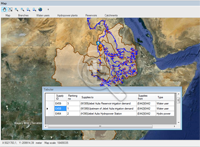 MIKE HYDRO Basin is our new generation of integrated river basin analysis software for water resources planning and management.
MIKE HYDRO Basin was introduced with the current release 2012, containing a large number of features relevant for integrated river basin management applications. Developments continue for MIKE HYDRO Basin and the new release will introduce another very interesting new feature to modellers of river basin water allocation schemes and resources management; Global Prioritisation.
With this new feature, it is now possible to include a user defined prioritisation of water users within the basin model - regardless of their geographical location within the basin. Thus, it highly increases the applicability of MIKE HYDRO Basin for specific types of water resources management applications.
The global prioritisation of water users are defined through ‘Ranking’ number definitions, where water consumers are assigned an individual ranking number. The ranking numbers are used during simulation to prioritise consumers, in case of water shortage, in order to accommodate the water demands for these - taking into account that some users have a higher priority than others.
Mesh Generation: A new tool for creating flexible meshes from dfs2 files and other sources
 The combination of high flexibility of flexible meshes (FM) and impressive performance improvements, introduced in the latest releases of MIKE by DHI, make the use of FM versions of MIKE 21, MIKE 3 and MIKE FLOOD even more attractive. Improvements in recent releases include, amongst others, the introduction of shared memory based parallelisation, porting of simulation engines to LINUX and, in Release 2014, supporting Graphical Processing Units (GPUs) for MIKE 21 HD FM.
In order to assist those, who want to transfer existing models or bathymetries into the FM system, Release 2014 will contain a new tool, aimed to convert bathymetries in other formats into FM format.
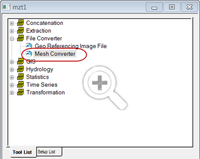
The new Mesh Converter is included in the MIKE Zero Toolbox and supports DHI’s own format from the ‘classic’ modelling series, dfs2 as well as some external formats (ADCIRC, SMS, TUFLOW). The process is quick and easy and produces an equal bathymetry in FM format, which can then be modified using all the existing editing facilities of MIKE Zero’s Mesh Generator.
New features in FEFLOW 6.2
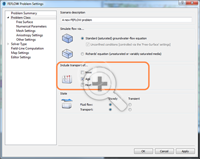 FEFLOW 6.2 offers a number of new features to enhance your groundwater modelling work.
Storage Capture/Release is a new component in the Rate Budget and Period Budget Panels for flow and transport in FEFLOW 6.2. With this new component, you can clearly separate storage change and solution error in transient models.
Increased performance with new MIKE 1D features in MIKE URBAN
Strengthening wastewater modelling projects with new features in WEST 2014
We are also pleased to inform you that Release 2014 of WEST will include a plant wide model (PWM) for simulating nutrient removal activated sludge systems.
The plant wide model is developed jointly by our WEST Development Centres, the Universities of Cape Town (UCT) and kwaZulu-Natal in South Africa.
Approximately once a year, we release a new version of our MIKE by DHI software - and this year is no exception. We would like to reveal herewith a preview of some of the new and exciting features to be released in December. We hope these new features will improve your experience with our software products, regarding usability, productivity as well as enhanced applications.
New possibilities of including moving objects in your animations
Ever wanted to add moving objects to your animations? This is possible with Release 2014.
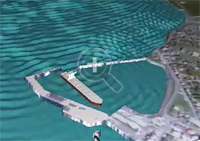 |
| Click here to view an example of the possibilities of this new feature. |
With MIKE Animator Plus, you can create visual animations to present you model results – and as something new, you will be able to include visualisation of solids. Through the inclusion of solids, you can improve your animations significantly by enhancing realism and recognition of locations, for example by including fixed elements like buildings and dams or moving elements like ships. Release 2014 will support the placement of solids inside the model domain and allow them to move, which means that a ship can be sailing as part of the animation.
MIKE HYDRO Basin: Global prioritisation of water users
MIKE HYDRO Basin was introduced with the current release 2012, containing a large number of features relevant for integrated river basin management applications. Developments continue for MIKE HYDRO Basin and the new release will introduce another very interesting new feature to modellers of river basin water allocation schemes and resources management; Global Prioritisation.
With this new feature, it is now possible to include a user defined prioritisation of water users within the basin model - regardless of their geographical location within the basin. Thus, it highly increases the applicability of MIKE HYDRO Basin for specific types of water resources management applications.
The global prioritisation of water users are defined through ‘Ranking’ number definitions, where water consumers are assigned an individual ranking number. The ranking numbers are used during simulation to prioritise consumers, in case of water shortage, in order to accommodate the water demands for these - taking into account that some users have a higher priority than others.
Mesh Generation: A new tool for creating flexible meshes from dfs2 files and other sources
In order to assist those, who want to transfer existing models or bathymetries into the FM system, Release 2014 will contain a new tool, aimed to convert bathymetries in other formats into FM format.
The new Mesh Converter is included in the MIKE Zero Toolbox and supports DHI’s own format from the ‘classic’ modelling series, dfs2 as well as some external formats (ADCIRC, SMS, TUFLOW). The process is quick and easy and produces an equal bathymetry in FM format, which can then be modified using all the existing editing facilities of MIKE Zero’s Mesh Generator.
New features in FEFLOW 6.2
Groundwater age calculation in FEFLOW 6.2
Groundwater Age is a new type of problem class, similar to mass or heat transport. With this, many questions can be easily answered, such as:
- How long is the average underground travel time of water pumped at a well?
- What‘s the percentage of bank filtration at the supply wells?
- What‘s the age and remaining travel time of groundwater at a certain location?
Storage Capture/Release is a new component in the Rate Budget and Period Budget Panels for flow and transport in FEFLOW 6.2. With this new component, you can clearly separate storage change and solution error in transient models.
Increased performance with new MIKE 1D features in MIKE URBAN
In 2012, we introduced a new generic 1D numerical engine for MIKE by DHI products. With the upcoming release of MIKE URBAN 2014, a number of new features for MIKE 1D will be available such as:
- coupling to MIKE SHE
- options for Advection-Dispersion modelling
- result presentation in MIKE URBAN
- and many more…
Strengthening wastewater modelling projects with new features in WEST 2014
Our WEST software package, for modelling wastewater treatment plants, has quickly established itself as an important product in the MIKE by DHI family with a growing number of users all over the world. Release 2014 includes several important new features, including:
- New Report Generator, which enables the user to automatically create reports containing graphs and data pertaining to a project in a variety of formats including: project information, plant layout, plots and tables.
- Integrated urban water system (IUWS) libraries, making WEST a powerful tool for identifying synergies and to globally optimise the wastewater system performance on a catchment scale.
We are also pleased to inform you that Release 2014 of WEST will include a plant wide model (PWM) for simulating nutrient removal activated sludge systems.
The plant wide model, ‘PWM_SA’, is a three phase model for the simulation of nutrient removal activated sludge systems coupled with the anaerobic (organisms independent of oxygen), aerobic (organisms dependent on oxygen) and anoxic-aerobic digestion of sewage sludge. This includes waste activated sludge produced by biological excess phosphorus removal plants. The model is based on strict material mass balance and is prepared by linking:
- a variation of ASM2 for activated sludge nitrogen and phosphorus removal and aerobic or anoxic–aerobic digestion
- a variation of the UCT anaerobic digestion model.
The plant wide model is developed jointly by our WEST Development Centres, the Universities of Cape Town (UCT) and kwaZulu-Natal in South Africa.
Screencasts FEFLOW Tutorials
FEFLOW Tutorial No. 3 - User Interface
The remaining tutorials can be accessed from our FEFLOW website here, or via our YouTube channel here. The screencasts show a number of workflows in the FEFLOW user interface. The numbers of the videos refer to chapters in the FEFLOW User Manual, where all these tutorials are described in a detailed, step-by-step way.
Screencasts FEFLOW Demonstration Exercise
FEFLOW Demo Exercise No. 1 - Working with maps
The remaining demo exercises can be accessed from our FEFLOW website here, or via our YouTube channel here. These animations refer to the Demonstration Exercise that can be downloaded from manuals page. The exercise can be repeated by using the free demo version of FEFLOW available from download page.
FEFLOW Tutorial No. 3 - User Interface
The remaining tutorials can be accessed from our FEFLOW website here, or via our YouTube channel here. The screencasts show a number of workflows in the FEFLOW user interface. The numbers of the videos refer to chapters in the FEFLOW User Manual, where all these tutorials are described in a detailed, step-by-step way.
Screencasts FEFLOW Demonstration Exercise
FEFLOW Demo Exercise No. 1 - Working with maps
The remaining demo exercises can be accessed from our FEFLOW website here, or via our YouTube channel here. These animations refer to the Demonstration Exercise that can be downloaded from manuals page. The exercise can be repeated by using the free demo version of FEFLOW available from download page.
Thursday, 14 November 2013
Previews of MIKE by DHI Release 2014
Approximately once a year, we release a new version of our MIKE by DHI software - and this year is no exception. We would like to reveal herewith a preview of some of the new and exciting features to be released later this year. We hope these new features will improve your experience with our software products, regarding usability, productivity as well as enhanced applications.
MIKE Zero 2014 – beyond memory limitations
Unleash the full potential of your hardware with MIKE Zero release 2014.
 MIKE Zero is the overall graphical user interface (GUI) framework for most of the MIKE by DHI products and the coming release will introduce the entire MIKE Zero framework to our users as a true 64-bit application. This completes the transition process of MIKE Zero based products from 32-bit applications with Windows operating system limitations on memory usage to unlimited and true 64-bit applications.
It includes all MIKE Zero user interface components, toolboxes and utilities as well as our computational engines.
Memory usage is now only limited by your hardware. Common, memory demanding operations such as high resolution mesh generation, results analysis and processing are now possible without any risk of limitations from built-in limitations within your PC’s operating system. Enjoy the unlimited capabilities of MIKE Zero with Release 2014 of MIKE by DHI!
Including overtopping in MIKE 21 and MIKE 3
 In the last few years, there has been a growing focus on the phenomenon of overtopping of coastal structures like sea walls and other defence structures. This increased interest is due to more frequent loss of human life and economic losses.
In release 2014 of MIKE 21 HD and MIKE 3 HD (FM versions), we are introducing a new feature that gives you the possibility of including overtopping in your hydrodynamic simulations.
In release 2012, a new dike structure was introduced that made it possible to use this type of structures in a flexible manner. This dike structure has now been enhanced allowing you to choose either to directly specify the overtopping discharge or to have the overtopping discharge calculated by specifying a table that expresses the overflow as a function of the freeboard, wave height and period. The direct specification of overtopping can be constant or varying – both in time and along the dike.
When you choose to have the overtopping calculated, the dynamic variation of the simulation results is taken into account. We expect to introduce more developments of these aspects in upcoming versions.
Restore and recreate views in FEFLOW with the new scene library panel
The new FEFLOW 6.2 will feature a very convenient tool to store different views in your FEFLOW model or results files. Supermesh, slice, 3D and cross-section view settings can be stored in a Scene Library panel, which will allow you to easily restore or recreate views from stored scenes. The library will provide different filters and an option to create folders and lists in order to organise the stored scenes according to your preferences.
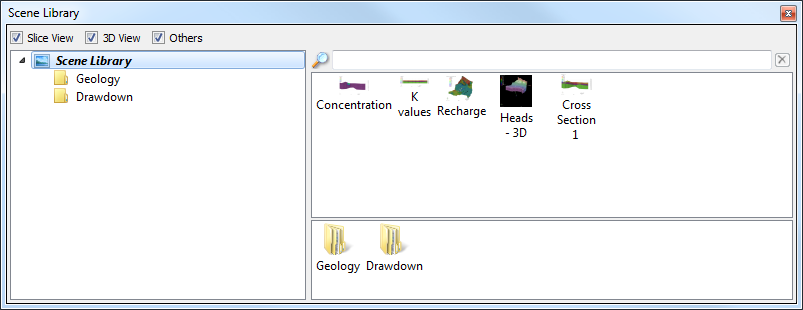 As an additional benefit, the provided import and export functionality will facilitate the creation of a large number of identical views in different model scenarios – all with just a few mouse clicks.
With this new feature, view windows no longer need to remain open in order not to lose the chosen view settings but can be stored in the Scene Library. This will require less memory usage and CPU time.
Approximately once a year, we release a new version of our MIKE by DHI software - and this year is no exception. We would like to reveal herewith a preview of some of the new and exciting features to be released later this year. We hope these new features will improve your experience with our software products, regarding usability, productivity as well as enhanced applications.
MIKE Zero 2014 – beyond memory limitations
Unleash the full potential of your hardware with MIKE Zero release 2014.
It includes all MIKE Zero user interface components, toolboxes and utilities as well as our computational engines.
Memory usage is now only limited by your hardware. Common, memory demanding operations such as high resolution mesh generation, results analysis and processing are now possible without any risk of limitations from built-in limitations within your PC’s operating system. Enjoy the unlimited capabilities of MIKE Zero with Release 2014 of MIKE by DHI!
Including overtopping in MIKE 21 and MIKE 3
In release 2014 of MIKE 21 HD and MIKE 3 HD (FM versions), we are introducing a new feature that gives you the possibility of including overtopping in your hydrodynamic simulations.
In release 2012, a new dike structure was introduced that made it possible to use this type of structures in a flexible manner. This dike structure has now been enhanced allowing you to choose either to directly specify the overtopping discharge or to have the overtopping discharge calculated by specifying a table that expresses the overflow as a function of the freeboard, wave height and period. The direct specification of overtopping can be constant or varying – both in time and along the dike.
When you choose to have the overtopping calculated, the dynamic variation of the simulation results is taken into account. We expect to introduce more developments of these aspects in upcoming versions.
Restore and recreate views in FEFLOW with the new scene library panel
The new FEFLOW 6.2 will feature a very convenient tool to store different views in your FEFLOW model or results files. Supermesh, slice, 3D and cross-section view settings can be stored in a Scene Library panel, which will allow you to easily restore or recreate views from stored scenes. The library will provide different filters and an option to create folders and lists in order to organise the stored scenes according to your preferences.
As an additional benefit, the provided import and export functionality will facilitate the creation of a large number of identical views in different model scenarios – all with just a few mouse clicks.With this new feature, view windows no longer need to remain open in order not to lose the chosen view settings but can be stored in the Scene Library. This will require less memory usage and CPU time.
Sunday, 24 March 2013
Photos from the second day (20th March 2013)!

Thanks to everyone who participated in the training sessions!
Thanks to everyone who participated in the training sessions!
Thursday, 21 February 2013
The use of 3D numerical modelling in groundwater research and water quality risk assessment
Matrix Solutions Inc. in Canada is using MIKE by DHI numerical modelling for ground-breaking research and valuable solutions for their clients. Two recent examples are: -
Feasibility study estimating lithium and potash rich brine deposit reserves
Matrix Solutions developed a 3D numerical modelling tool using among others FEFLOW to represent the complex groundwater flow system and evaluate various wellfield strategies. Using FEFLOW to develop their numerical model, Matrix Solutions was able to significantly reduce simulation time and reach a conclusion supporting a long time and low cost mining operation.
The importance of groundwater–surface water interaction in water resource assessments
In order to better understand and assess the groundwater –surface water interaction, Matrix Solutions applied our integrated modelling software MIKE SHE to two municipal water quality risk assessments in order to evaluate the sustainability of municipal water withdrawals.
Read more in the Matrix Solutions newsletter.
Read the full January 2013 Edition of the MIKE by DHI NetWork newsletter here. Read other recent DHI news stories here.
Matrix Solutions Inc. in Canada is using MIKE by DHI numerical modelling for ground-breaking research and valuable solutions for their clients. Two recent examples are: -
Feasibility study estimating lithium and potash rich brine deposit reserves
Matrix Solutions developed a 3D numerical modelling tool using among others FEFLOW to represent the complex groundwater flow system and evaluate various wellfield strategies. Using FEFLOW to develop their numerical model, Matrix Solutions was able to significantly reduce simulation time and reach a conclusion supporting a long time and low cost mining operation.
The importance of groundwater–surface water interaction in water resource assessments
In order to better understand and assess the groundwater –surface water interaction, Matrix Solutions applied our integrated modelling software MIKE SHE to two municipal water quality risk assessments in order to evaluate the sustainability of municipal water withdrawals.
Read more in the Matrix Solutions newsletter.
Read the full January 2013 Edition of the MIKE by DHI NetWork newsletter here. Read other recent DHI news stories here.
Monday, 19 November 2012
Top award for Managed Aquifer Recharge (MAR) Scheme using FEFLOW
The Fortescue Metals Group (FMG) recently won top honours at the International Water Association’s prestigious Project Innovation Awards at the World Water Congress in Korea. The prize was awarded for an innovative Managed Aquifer Recharge (MAR) scheme at Fortescue’s Cloudbreak and Christmas Creek iron ore mines in the Pilbara region of Western Australia. DHI provided assistance to FMG in the design and development of high-spatial-resolution groundwater models using FEFLOW for this project.
The MAR scheme mitigates environmental impact of surface discharge and dewatering drawdown and conserves brackish water resources for future mine water supply. The mine operations are bounded on the south by the Fortescue Marsh, an ephemeral wetland of national significance that is underlain by hypersaline groundwater. The project is one of the largest MAR schemes in Australia and is the first of its kind in highly saline groundwater.
 Figure: A Simplified Schematic of The Cloudbreak Managed Aquifer Recharge (MAR) scheme
The MAR scheme is part of the mine dewatering operation. The scheme allows FMG to pump almost 75% of the extracted water back into the local groundwater system instead discharging it to streams, where it would be largely lost to evaporation in the arid climate. The current operation has been operating as a sustainable ‘closed’ system with zero surface discharge since September 2009. The FEFLOW models enable FMG to predict the movement of the saline/brackish groundwater interface in response to different operating conditions. The models also help forecast the quantity and salinity of groundwater extracted under different mine plans. The current 40-gigalitre/year operation may grow to over 100 gigalitre/year as the Cloudbreak mine expands and the Christmas Creek mine comes on-line.
The Fortescue project showcases how Managed Aquifer Recharge, together with FEFLOW, can be used to meet a range of objectives in a complex environment, including coast aquifers. MAR is relevant in many environments, and is likely to be increasingly used at mine sites around the world facing varied and difficult water management challenges.
For more information please contact Stefan Paul Szylkarski at sps@dhigroup.com
The Fortescue Metals Group (FMG) recently won top honours at the International Water Association’s prestigious Project Innovation Awards at the World Water Congress in Korea. The prize was awarded for an innovative Managed Aquifer Recharge (MAR) scheme at Fortescue’s Cloudbreak and Christmas Creek iron ore mines in the Pilbara region of Western Australia. DHI provided assistance to FMG in the design and development of high-spatial-resolution groundwater models using FEFLOW for this project.
The MAR scheme mitigates environmental impact of surface discharge and dewatering drawdown and conserves brackish water resources for future mine water supply. The mine operations are bounded on the south by the Fortescue Marsh, an ephemeral wetland of national significance that is underlain by hypersaline groundwater. The project is one of the largest MAR schemes in Australia and is the first of its kind in highly saline groundwater.
The MAR scheme is part of the mine dewatering operation. The scheme allows FMG to pump almost 75% of the extracted water back into the local groundwater system instead discharging it to streams, where it would be largely lost to evaporation in the arid climate. The current operation has been operating as a sustainable ‘closed’ system with zero surface discharge since September 2009. The FEFLOW models enable FMG to predict the movement of the saline/brackish groundwater interface in response to different operating conditions. The models also help forecast the quantity and salinity of groundwater extracted under different mine plans. The current 40-gigalitre/year operation may grow to over 100 gigalitre/year as the Cloudbreak mine expands and the Christmas Creek mine comes on-line.
The Fortescue project showcases how Managed Aquifer Recharge, together with FEFLOW, can be used to meet a range of objectives in a complex environment, including coast aquifers. MAR is relevant in many environments, and is likely to be increasingly used at mine sites around the world facing varied and difficult water management challenges.
For more information please contact Stefan Paul Szylkarski at sps@dhigroup.com
Sunday, 18 November 2012
Transforming abandoned mining pits into new lake districts
The mining industry can have severe consequences for regions and the surrounding landscape, impacting vegetation and wildlife negatively when mining production is abandoned. Rehabilitating old mining areas can be a highly difficult challenge and few succeed.
 However, with the right strategies and tools available, abandoned mining pits can be turned from lifeless landscapes into prosperous manmade lake districts. This is what has been done in Eastern Germany, where DHI-WASY was able to provide accurate analysis and the right strategies for creating a new lake. For this purpose, integrated groundwater modelling was essential using among other products FEFLOW 6.1 and MIKE 11.
Click here to read more.
Read the full November 2012 Edition of the MIKE by DHI NetWork newsletter here.
Dynamic response of floating offshore wind turbines
As a member of the HYDRALAB-IV consortium, we offer access to research groups to conduct experimental studies in our wave basins. One of the projects selected by HYDRALAB's user selection panel for Transnational Access to our facilities concerns 'Dynamic Response of Floating offshore Structures under Random Waves and Wind Action'.
Other recent DHI news stories
The mining industry can have severe consequences for regions and the surrounding landscape, impacting vegetation and wildlife negatively when mining production is abandoned. Rehabilitating old mining areas can be a highly difficult challenge and few succeed.
Click here to read more.
Read the full November 2012 Edition of the MIKE by DHI NetWork newsletter here.
Dynamic response of floating offshore wind turbines
As a member of the HYDRALAB-IV consortium, we offer access to research groups to conduct experimental studies in our wave basins. One of the projects selected by HYDRALAB's user selection panel for Transnational Access to our facilities concerns 'Dynamic Response of Floating offshore Structures under Random Waves and Wind Action'.
Other recent DHI news stories
- We support IMPAQ in investigating zooplankton impacts on larval fish growth
- Development of innovative technology for treatment of hospital wastewater
- Testing floating wind turbines in DHI’s offshore basin
- We sign a new real-time forecasting contract with Slovenia
- EUPORIAS – the next step in seasonal forecasting
- Decommissioning a former nuclear weapons manufacturing facility
- We help to drive European wave and tidal power generation forward
Sunday, 9 September 2012
FEFLOW 6.1 is here!
We are proud to announce that FEFLOW 6.1 is now available with all new features and numerous improvements that enhance performance and usability.
 The release of FEFLOW 6.1 marks a significant milestone, making FEFLOW even more productive and intuitive. With the previous FEFLOW 6.0, a new standard user interface was introduced phasing out the classic user interface that has been used for more than 20 years. Now with FEFLOW 6.1, the migration is complete making the entire functionality from mesh generation via simulation to postprocessing available in the redesigned, modern user interface. In addition, a wide range of new functionalities are available. Click here to view highlights of the most important new features and improvements.

FEFLOW users with a valid service and maintenance agreement (SMA) will automatically receive the new version as well as new key codes. If your SMA has expired, please contact the FEFLOW sales team and they will be happy to assist you with renewing it applying special release conditions.
FEFLOW 6.1 is available for public download here.
For more information about Leapfrog Hydro and FEFLOW, please click here.
For more information about FEFLOW 6.1 or to purchase the new version, please contact the FEFLOW sales team.
.
We are proud to announce that FEFLOW 6.1 is now available with all new features and numerous improvements that enhance performance and usability.
FEFLOW users with a valid service and maintenance agreement (SMA) will automatically receive the new version as well as new key codes. If your SMA has expired, please contact the FEFLOW sales team and they will be happy to assist you with renewing it applying special release conditions.
FEFLOW 6.1 is available for public download here.
FEFLOW & LEAPFROG
Experience the complete toolset for hydrogeological modelling!
Joining the powers of the best-in-class geologic and groundwater modelling tools: Easily build detailed geologic models in Leapfrog Hydro and seamlessly transfer them to FEFLOW which can handle your most demanding groundwater simulation tasks.

For more information about Leapfrog Hydro and FEFLOW, please click here.
For more information about FEFLOW 6.1 or to purchase the new version, please contact the FEFLOW sales team.
.
Saturday, 14 July 2012
FEFLOW 2012

3rd International FEFLOW® User Conference
3rd - 7th September 2012
Berlin, Germany
 Building on the success of the previous FEFLOW user conferences, FEFLOW 2012 will feature numerous opportunities for exchanging ideas and improving modelling skills. Highlights include keynote presentations, user presentations, product updates, opportunities to meet with DHI-WASY partners and FEFLOW users worldwide, software demonstrations, training courses, and workshops.
For further information and registration, please go to the Conference website here.
.
3rd International FEFLOW® User Conference
3rd - 7th September 2012
Berlin, Germany
For further information and registration, please go to the Conference website here.
.
Previews of MIKE by DHI Release 2012
As in previous issues of our newsletter, we would like to disclose a preview of the upcoming MIKE by DHI software package 2012, which is scheduled to be released this September. The release will contain various new and exciting features, which we hope will improve your experience when using the software products, both with regard to usability, productivity, and enhanced applications.
FEFLOW 6.1: Finding the ideal discretisation near wells and point sources
 The discretisation of point sources (like well boundary conditions) in discretised numerical model is a critical requirement if an accurate drawdown needs to be calculated. At point-type boundary conditions (such as wells or solitary fixed potentials), the element size has a direct influence on the computed drawdown or flux. If being disregarded, the result might vary by up to orders of magnitude.
As FEFLOW uses a flexible meshing technology, the user is able to adapt the element size near wells and other point sources to the necessary discretisation. This ideal node distance depends on the radius of the well in reality and the number of neighbour nodes. To facilitate the calculation and implementation of this distance, multilayer wells and borehole heat exchangers have been equipped with special viewing styles that guide the user on how to adapt the mesh to its ideal shape.
 The figures illustrate the easiness of the workflow. First, a mesh is created (e.g. using the triangle method) with an approximated node distance (6 x well radius). Afterwards, a multilayer well is created. The viewing style “ideal element size” displays a circle indicating the ideal distance of the neighbouring nodes. After manually placing the nodes on this circle, the area indicated by the “geometry“-style (well radius in reality) will be matched by the “virtual well radius” (equivalent well radius in the discretised model).
These and many new features are already available in the FEFLOW 6.1 public beta.
.
As in previous issues of our newsletter, we would like to disclose a preview of the upcoming MIKE by DHI software package 2012, which is scheduled to be released this September. The release will contain various new and exciting features, which we hope will improve your experience when using the software products, both with regard to usability, productivity, and enhanced applications.
FEFLOW 6.1: Finding the ideal discretisation near wells and point sources
As FEFLOW uses a flexible meshing technology, the user is able to adapt the element size near wells and other point sources to the necessary discretisation. This ideal node distance depends on the radius of the well in reality and the number of neighbour nodes. To facilitate the calculation and implementation of this distance, multilayer wells and borehole heat exchangers have been equipped with special viewing styles that guide the user on how to adapt the mesh to its ideal shape.
These and many new features are already available in the FEFLOW 6.1 public beta.
.
Saturday, 7 July 2012
Previews of MIKE by DHI Release 2012
As in previous issues of our newsletter, we would like to disclose a preview of the upcoming MIKE by DHI software package 2012, which is scheduled to be released this September. The release will contain various new and exciting features, which we hope will improve your experience when using the software products, both with regard to usability, productivity, and enhanced applications.
Climate Change Tool: Sea Level Rise included
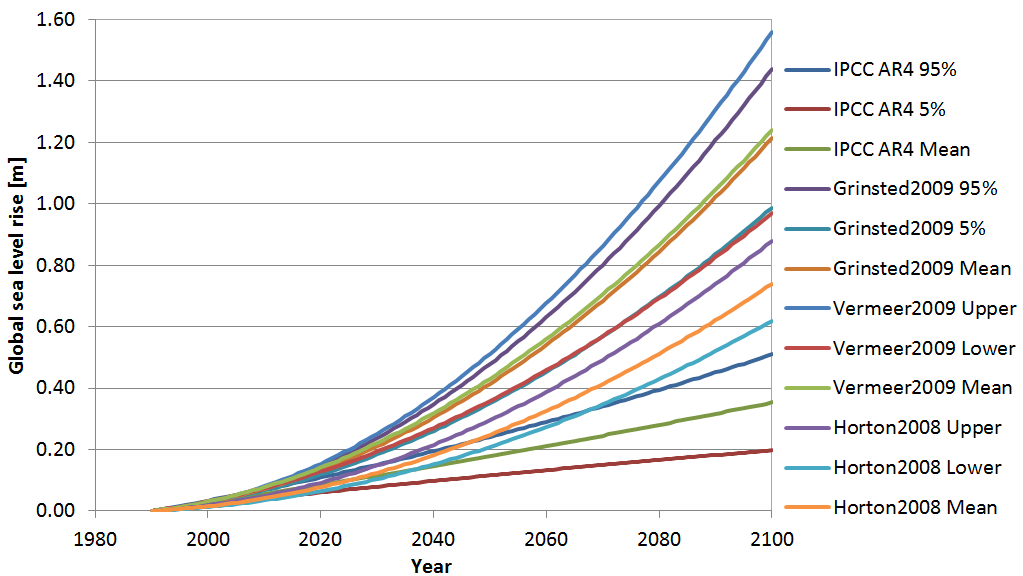
One of the interesting news in version 2012 of the Climate Change Tool is that Sea Level Rise scenarios are now included. The Climate Change Tool works on existing model setups and modifies the boundary conditions according to a chosen forecast (Global Circulation Model and Emission Scenario) and forecast year.
The changes in sea level are obviously of crucial interest for a number of applications, for example related to coastal defence works. In version 2012 of the tool, global mean sea level change is included as assessed in the IPCC Assessment Report No 4 and in three posterior estimations, in all cases for three different emission scenarios.
In order to evoke the Sea Level Rise changes, the user has to define:
Click on the figure to enlarge.
FEFLOW 6.1: Watching the calibration quality
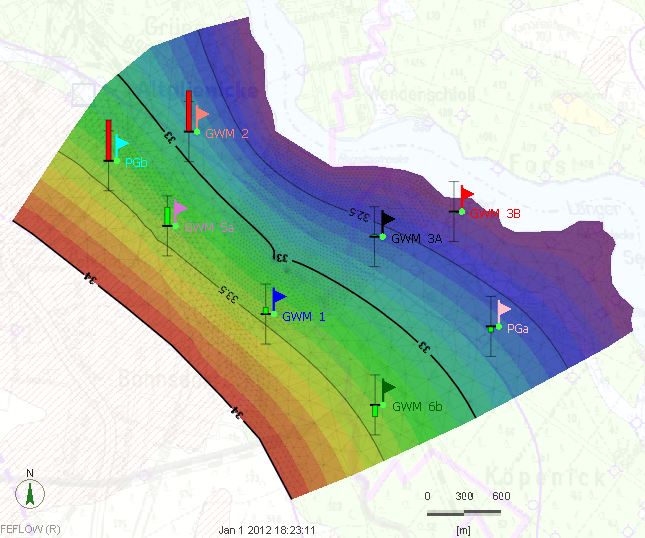
Another new feature concerns the calibration quality in FEFLOW 6.1. The calibration process is one of the most important and often most elaborate working steps when modelling groundwater systems. Having an easy and prompt response of the match between field data and computed values significantly reduces effort.
In FEFLOW 6.1, in-line visualisation of the local calibration quality at observation points assists the user during the calibration process (see figure). The deviation from the calibration target is depicted as an error bar where different colours accentuate possible violation of confidence intervals. Scatter plots finally summarise the overall match between measured and computed values.
Click on the image to enlarge.
For more information, please contact Alexander Renz, DHI-Wasy, Germany.
.
As in previous issues of our newsletter, we would like to disclose a preview of the upcoming MIKE by DHI software package 2012, which is scheduled to be released this September. The release will contain various new and exciting features, which we hope will improve your experience when using the software products, both with regard to usability, productivity, and enhanced applications.
Climate Change Tool: Sea Level Rise included
One of the interesting news in version 2012 of the Climate Change Tool is that Sea Level Rise scenarios are now included. The Climate Change Tool works on existing model setups and modifies the boundary conditions according to a chosen forecast (Global Circulation Model and Emission Scenario) and forecast year.
The changes in sea level are obviously of crucial interest for a number of applications, for example related to coastal defence works. In version 2012 of the tool, global mean sea level change is included as assessed in the IPCC Assessment Report No 4 and in three posterior estimations, in all cases for three different emission scenarios.
In order to evoke the Sea Level Rise changes, the user has to define:
- Selected sea level rise model (including choice of lower, mean or upper level)
- Projection year
- Emission scenario
Click on the figure to enlarge.
FEFLOW 6.1: Watching the calibration quality
Another new feature concerns the calibration quality in FEFLOW 6.1. The calibration process is one of the most important and often most elaborate working steps when modelling groundwater systems. Having an easy and prompt response of the match between field data and computed values significantly reduces effort.
In FEFLOW 6.1, in-line visualisation of the local calibration quality at observation points assists the user during the calibration process (see figure). The deviation from the calibration target is depicted as an error bar where different colours accentuate possible violation of confidence intervals. Scatter plots finally summarise the overall match between measured and computed values.
Click on the image to enlarge.
For more information, please contact Alexander Renz, DHI-Wasy, Germany.
.
Friday, 6 July 2012
Previews of MIKE by DHI Release 2012
As mentioned in the previous issues of our newsletter, we would like to disclose some previews of the upcoming MIKE by DHI software package 2012, which is scheduled to be released this September. The release will contain various new and exciting features, which we hope will improve your experience when using the software products, both with regard to usability, productivity, and enhanced applications.
MIKE 21: New wave spectra converter
With the primary goal to improve and ease the generation of boundary conditions for MIKE 21 SW, the upcoming 2012 version will include a new Wave Spectra Converter tool in the wave toolbox.
Boundary conditions for MIKE 21 SW are often based on integral wave parameters (significant wave height, peak wave period, mean wave direction, etc.) available from public sources. Actually, full wave spectral information is often available but it has been complicated to generate the required data for a MIKE 21 SW boundary. This new tool will solve this problem by making it possible to manipulate full wave spectra, including the generation of fully spectral boundary data for MIKE 21 SW.
Please click on the illustration to view larger version.

FEFLOW 6.1: Visualising the groundwater surface
With the upcoming release 2012, modelling groundwater with FEFLOW is scheduled to take an important step forward by improving the usability, comprehensibility and speeding up the workflow process.
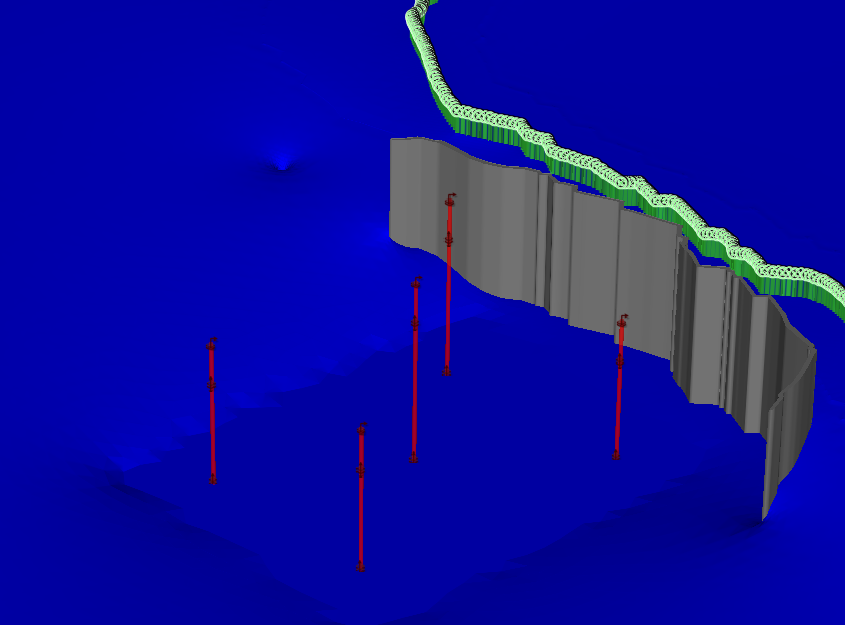
Visualising the groundwater surface improves the understanding of groundwater models dramatically. Using the pressure, this visualisation can be achieved by restricting the parameters’ range to zero. This is already possible with FEFLOW 6.0, but requires some effort in order to adjust the view settings. With the new FEFLOW 6.1, zero pressure isosurfaces are added for the 3D and zero pressure isolines for the 2D views. Both become directly available when plotting the pressure in the view components and thus speeding up the visualisation process.
Please click on the image, to view a larger version.
MIKE URBAN: Catchment delineation from digital elevation models
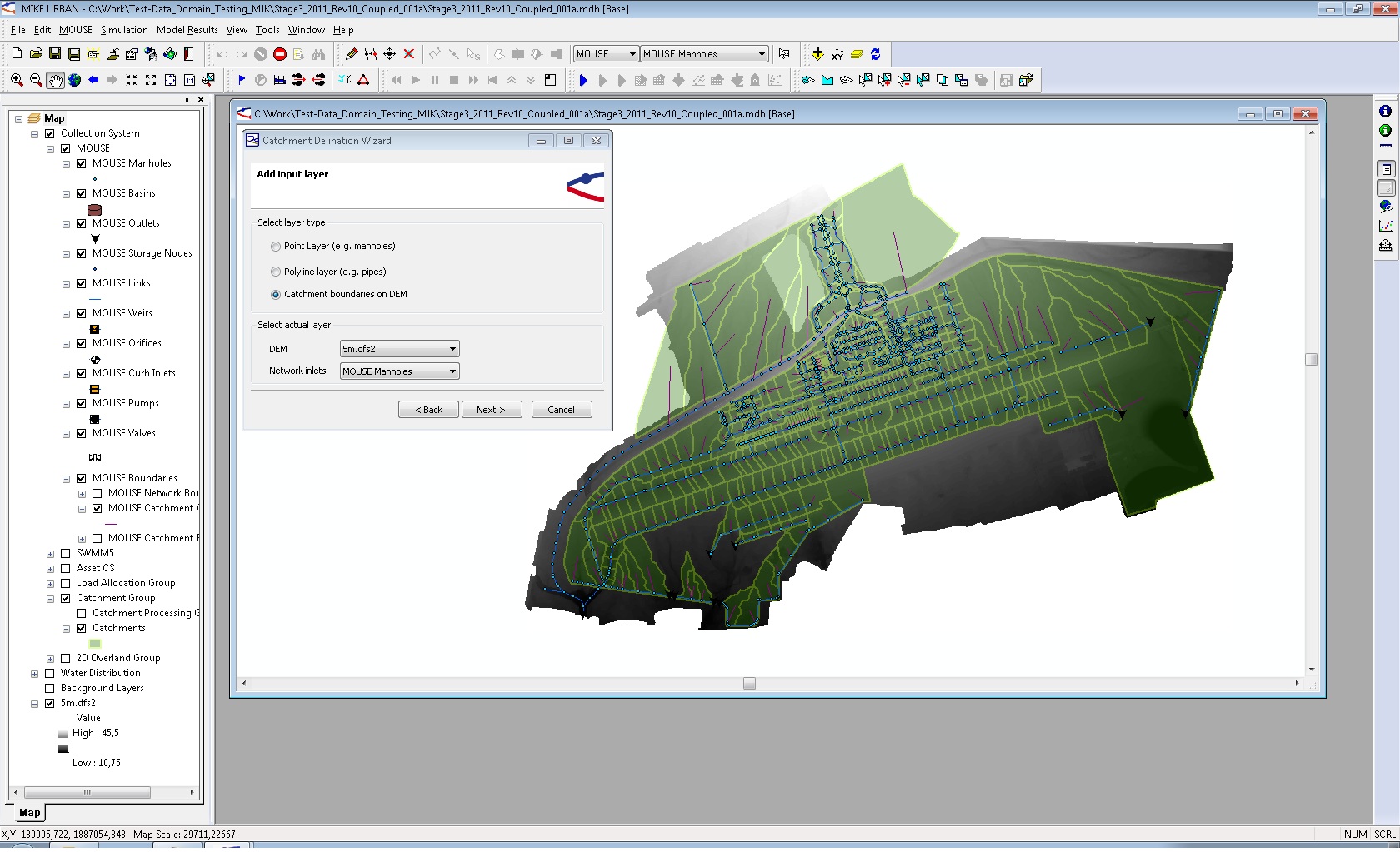
Catchment delineation is one of the essential steps for surface-runoff modelling. With MIKE URBAN version 2012 catchments, as a basic physical entity of the landscape, can be derived easily from digital elevation models (DEM). The number of available DEMs as well as the spatial resolution has been increased rapidly over the last years. Using this delineation technique will improve accuracy of the catchment delineation compared to a pure geometrical method (e.g. Thiessen polygons). The technique involved is well known as it is already utilised in MIKE BASIN.
Please click on the image to view a larger version.
As mentioned in the previous issues of our newsletter, we would like to disclose some previews of the upcoming MIKE by DHI software package 2012, which is scheduled to be released this September. The release will contain various new and exciting features, which we hope will improve your experience when using the software products, both with regard to usability, productivity, and enhanced applications.
MIKE 21: New wave spectra converter
With the primary goal to improve and ease the generation of boundary conditions for MIKE 21 SW, the upcoming 2012 version will include a new Wave Spectra Converter tool in the wave toolbox.
Boundary conditions for MIKE 21 SW are often based on integral wave parameters (significant wave height, peak wave period, mean wave direction, etc.) available from public sources. Actually, full wave spectral information is often available but it has been complicated to generate the required data for a MIKE 21 SW boundary. This new tool will solve this problem by making it possible to manipulate full wave spectra, including the generation of fully spectral boundary data for MIKE 21 SW.
Please click on the illustration to view larger version.
FEFLOW 6.1: Visualising the groundwater surface
With the upcoming release 2012, modelling groundwater with FEFLOW is scheduled to take an important step forward by improving the usability, comprehensibility and speeding up the workflow process.
Visualising the groundwater surface improves the understanding of groundwater models dramatically. Using the pressure, this visualisation can be achieved by restricting the parameters’ range to zero. This is already possible with FEFLOW 6.0, but requires some effort in order to adjust the view settings. With the new FEFLOW 6.1, zero pressure isosurfaces are added for the 3D and zero pressure isolines for the 2D views. Both become directly available when plotting the pressure in the view components and thus speeding up the visualisation process.
Please click on the image, to view a larger version.
MIKE URBAN: Catchment delineation from digital elevation models
Catchment delineation is one of the essential steps for surface-runoff modelling. With MIKE URBAN version 2012 catchments, as a basic physical entity of the landscape, can be derived easily from digital elevation models (DEM). The number of available DEMs as well as the spatial resolution has been increased rapidly over the last years. Using this delineation technique will improve accuracy of the catchment delineation compared to a pure geometrical method (e.g. Thiessen polygons). The technique involved is well known as it is already utilised in MIKE BASIN.
Please click on the image to view a larger version.
Tuesday, 13 March 2012
Previews of MIKE by DHI 2012 Release
As detailed in the February 2012 issue of our newsletter, we would like to present some previews of the upcoming MIKE by DHI software package 2012, which is scheduled to be released this September. The release will contain various new and exciting features, which we hope will improve your experience when using the software products, both with regard to usability, productivity, and enhanced applications.
FEFLOW 6.1: Selective Mesh Smoothing for Finite-Element Meshes
 Now you can look forward to improved model quality and even faster modelling with the upcoming FEFLOW 6.1!
Smoothing a finite-element mesh can significantly improve the quality of a mesh that, in some cases, might be unsatisfactory after the generation process due to the presence of too many triangles with acute angles. Within groundwater modelling it is essential to keep hydraulic structures, e.g. well locations and other structures defined by the user at their original position. In FEFLOW 6.0, only a global mesh-smoothing option was available, which does not provide the means to exclude selected mesh nodes from shifting positions during the smoothing process.
With the upcoming version of FEFLOW 6.1, we have improved the smoothing functionality significantly: Smoothing can now be applied in selected areas of the finite-element mesh, only allowing maintaining the original positions of boundary conditions etc. as defined by the modeller.
WEST: How to convert plant layouts and experiments from older WEST versions?
The new WEST3 conversion tool allows for converting plant layouts and experiments from WEST 3.7.6 to WEST 2011. It will be available with the release 2012 and via download at the MIKE by DHI website.
Layouts that are based on the standard WEST model library are supported without further ado. During conversion, the user can choose whether to adopt the new WEST 2011 icons, or the old WEST 3.7.6 icons for the converted layout. The conversion tool does not require WEST 3.7.6 to be installed. However, it does require a valid WEST 2011 license.
Please do not hesitate to contact MIKE by DHI support if you have any questions related to WEST, or how to get the most out of the software.
MIKE URBAN: Storm Water Tools
With the release of MIKE URBAN 2012, the Storm Water Tools will be fully implemented into MIKE URBAN using either MOUSE or SWMM as simulation engine.
The MIKE URBAN Storm Water Tools focus on building the Storm Water model within a 1D framework. The tools supplement the standard MIKE URBAN installation by empowering the user with the ability to carry out:
As detailed in the February 2012 issue of our newsletter, we would like to present some previews of the upcoming MIKE by DHI software package 2012, which is scheduled to be released this September. The release will contain various new and exciting features, which we hope will improve your experience when using the software products, both with regard to usability, productivity, and enhanced applications.
FEFLOW 6.1: Selective Mesh Smoothing for Finite-Element Meshes
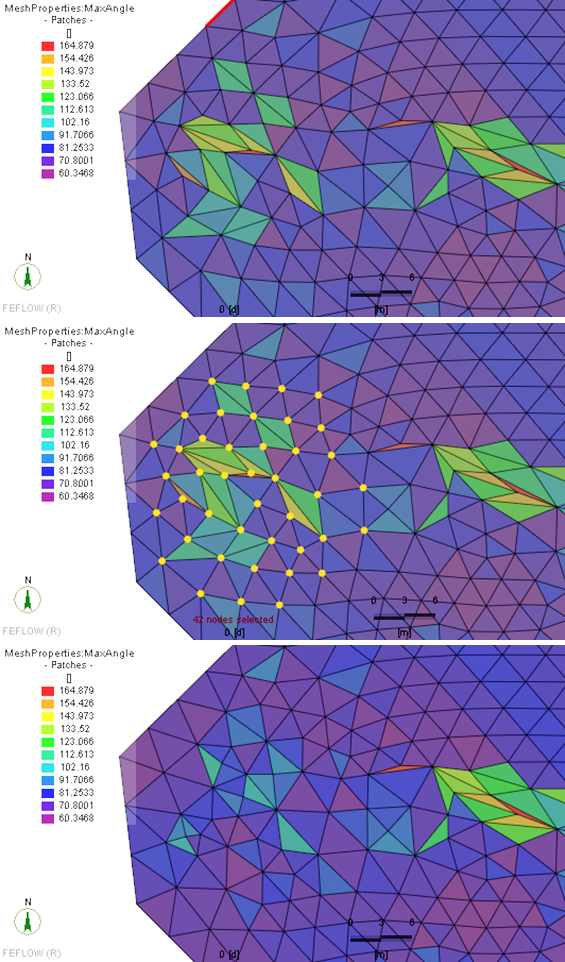
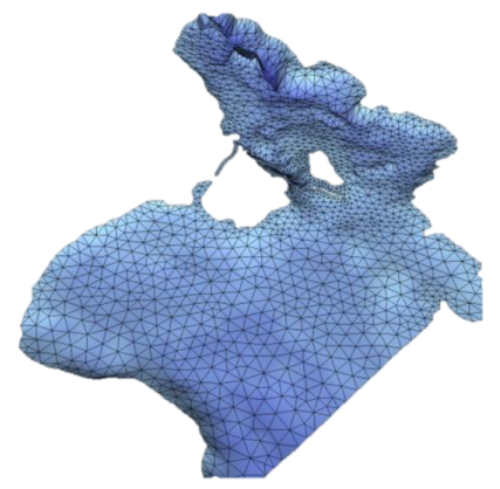
Smoothing a finite-element mesh can significantly improve the quality of a mesh that, in some cases, might be unsatisfactory after the generation process due to the presence of too many triangles with acute angles. Within groundwater modelling it is essential to keep hydraulic structures, e.g. well locations and other structures defined by the user at their original position. In FEFLOW 6.0, only a global mesh-smoothing option was available, which does not provide the means to exclude selected mesh nodes from shifting positions during the smoothing process.
With the upcoming version of FEFLOW 6.1, we have improved the smoothing functionality significantly: Smoothing can now be applied in selected areas of the finite-element mesh, only allowing maintaining the original positions of boundary conditions etc. as defined by the modeller.
WEST: How to convert plant layouts and experiments from older WEST versions?
The new WEST3 conversion tool allows for converting plant layouts and experiments from WEST 3.7.6 to WEST 2011. It will be available with the release 2012 and via download at the MIKE by DHI website.
Layouts that are based on the standard WEST model library are supported without further ado. During conversion, the user can choose whether to adopt the new WEST 2011 icons, or the old WEST 3.7.6 icons for the converted layout. The conversion tool does not require WEST 3.7.6 to be installed. However, it does require a valid WEST 2011 license.
Please do not hesitate to contact MIKE by DHI support if you have any questions related to WEST, or how to get the most out of the software.
MIKE URBAN: Storm Water Tools
With the release of MIKE URBAN 2012, the Storm Water Tools will be fully implemented into MIKE URBAN using either MOUSE or SWMM as simulation engine.
The MIKE URBAN Storm Water Tools focus on building the Storm Water model within a 1D framework. The tools supplement the standard MIKE URBAN installation by empowering the user with the ability to carry out:
- Lateral snapping of digitised rivers to the lowest point in DEM
- Cross section extractions from DEM
- Auto connections of overland network to sewer network
- Sequential labelling of nodes
- Catchment slope and length calculations
Highlights from The Network (March 2012)
The latest MIKE by DHI NetWork newsletter has been published, and a selected article is presented below: -
Application Examples
The newsletter can be viewed online here.
- Protecting clean drinking water from Lake Ontario, Canada:
Most of the North American region and in particular Ontario’s 13 million residents are highly dependent on clean drinking water from one of the Great Lakes. Thus, as contamination of the lakes could have severe consequences for many communities, a study was initiated to investigate potential threats to the water quality of Lake Ontario.
As a part of Ontario’s Source Water Protection program, a group called the Lake Ontario Collaborative was formed to study the potential threats to the drinking water. They have investigated potential impacts that activities on land, such as potential spills from surrounding waste water treatment plants, nuclear power plants, petroleum pipelines, and industrial facilities could have on the contamination of the water quality at the areas of intakes. For this purpose, they used an events-based approach, where potential spills were modelled by calculating the hydrodynamics as well as different aspects of the water quality. By using a full three dimensional illustration of water motion, including thermodynamics, it was possible to make accurate simulations and predictions of water currents in the lake and simulate the potential damage of a spill scenario.
As a result, they were able to develop intake protection zones. The zones were used to help raise awareness of the potential environmental and health risks that potential spills could entail as well as guide the preparation of emergency response planning in the event of a spill in the future. Want to read more? Click here.
To subscribe to the newsletter(s), please visit http://www.graphicmail.com/rwcode/subscribe.aspx?SiteID=3526&Mode=subscribe
Subscribe to:
Posts
(Atom)
Follow DHI...


