Sunday, 5 January 2014
FEFLOW Book released
The comprehensive book “FEFLOW – Finite Element Modeling of Flow, Mass and Heat Transport in Porous and Fractured Media” written by H.J. G. Diersch is now published by Springer (see the attached announcement).
It represents a theoretical textbook and covers a wide range of physical and computational issues in the field of porous/fractured-media modeling. The book starts with a more general theory for all relevant flow and transport phenomena on the basis of the continuum approach, systematically develops the basic framework for important classes of problems (e.g., multiphase/multispecies non-isothermal flow and transport phenomena, variably saturated porous media, free-surface groundwater flow, aquifer-averaged equations, discrete feature elements), introduces finite element techniques for solving the basic multidimensional balance equations, in detail discusses advanced numerical algorithms for the resulting nonlinear and linear problems, and completes with a number of benchmarks, applications and exercises to illustrate the different types of flow, mass and heat transport problems (e.g., subsurface flow and seepage problems, unsaturated-saturated flow, advective-diffusion transport, saltwater intrusion, geothermal and thermohaline flow).
The book is general and will be useful for both students and practitioners in engineering and geosciences as well as in other fields where porous-media flow dynamics and computational methods are of specific concern.
Links: -
DHI Sense is a new series of cost-optimised, mini-sensors for monitoring in water environments. It was developed in cooperation between DHI Denmark and DHI Singapore. The system design is aimed at optimising the value of measurement campaigns by increasing the number of sensors, while maintaining the overall cost of the operation.
Traditionally, very expensive, high-end scientific sensors have been used for marine monitoring. This has limited the number of stations that could be deployed during a measurement campaign. With DHI Sense, it is possible to deploy a network of numerous sensors at a comparable cost, without compromising the data quality. DHI Sense provides a new method for measurements where sensors are connected in a Master/Slave configuration. This is capable of controlling, processing and transmitting of online data from a large variety of sensors.
Data is by default stored locally on a Secure Digital Card. When configured for online operation, data – or a subset of data – is transferred to our Data Integration Management System (DIMS.CORE).
 |
| Read more >>> |
It represents a theoretical textbook and covers a wide range of physical and computational issues in the field of porous/fractured-media modeling. The book starts with a more general theory for all relevant flow and transport phenomena on the basis of the continuum approach, systematically develops the basic framework for important classes of problems (e.g., multiphase/multispecies non-isothermal flow and transport phenomena, variably saturated porous media, free-surface groundwater flow, aquifer-averaged equations, discrete feature elements), introduces finite element techniques for solving the basic multidimensional balance equations, in detail discusses advanced numerical algorithms for the resulting nonlinear and linear problems, and completes with a number of benchmarks, applications and exercises to illustrate the different types of flow, mass and heat transport problems (e.g., subsurface flow and seepage problems, unsaturated-saturated flow, advective-diffusion transport, saltwater intrusion, geothermal and thermohaline flow).
The book is general and will be useful for both students and practitioners in engineering and geosciences as well as in other fields where porous-media flow dynamics and computational methods are of specific concern.
Links: -
- www.springer.com/earth+sciences+and+geography/hydrogeology/book/978-3-642-38738-8
- www.amazon.com/FEFLOW-Element-Modeling-Transport-Fractured/dp/3642387381/
 |
| Read more >>> |
Traditionally, very expensive, high-end scientific sensors have been used for marine monitoring. This has limited the number of stations that could be deployed during a measurement campaign. With DHI Sense, it is possible to deploy a network of numerous sensors at a comparable cost, without compromising the data quality. DHI Sense provides a new method for measurements where sensors are connected in a Master/Slave configuration. This is capable of controlling, processing and transmitting of online data from a large variety of sensors.
Data is by default stored locally on a Secure Digital Card. When configured for online operation, data – or a subset of data – is transferred to our Data Integration Management System (DIMS.CORE).
Tuesday, 24 December 2013

Friday, 20 December 2013
MIKE by DHI 2014 is now available for download
 We are delighted to inform you that the new MIKE by DHI 2014 software package is available for download.
Release 2014 brings even more speed and flexibility to professional modellers around the world! If you value your time and want to discover how the world’s leading water modelling software can help you to even better productivity, please check it out. Our 30 day trial licences are free of charge!
MIKE by DHI covers the water environments in a highly integrated manner and with more features than ever before. Whether you are working within groundwater, urban water, wastewater, flooding, water resources, rivers, marine, ports or coasts - MIKE by DHI 2014 covers your modelling needs.
About MIKE by DHI 2014
JOIN AN ONLINE PRESENTATION
In January 2014, we have scheduled a number of online presentations in which you can learn more about what's new in MIKE by DHI 2014 and get the opportunity to ask questions. All times are in CET.
MORE INFORMATION
You can find more information about the new software package here.
You can also check out our new Software Catalogue 2014, which comprises information about new software features, an overview of our product offerings and much more.
MORE THAN JUST SOFTWARE
By using our software, you get access to a worldwide support system of people that are highly motivated to assist you and help you meet your deadlines. You also get access to THE ACADEMY by DHI, offering a unique selection of competence building and knowledge sharing activities, such as user events and professional training courses, enabling you to become an expert within your field. The online calendar is now updated with many new courses and events scheduled for 2014. Click here to find the next user group meeting or training course near you.
DOWNLOAD MIKE BY DHI 2014 NOW!
Download MIKE by DHI 2014 from our website at www.mikebydhi.com/download/MIKEBYDHI2014.aspx
If you have any questions about the new release, download, licences, or about our software in general, please contact mikebydhi.uk@dhigroup.com
Release 2014 brings even more speed and flexibility to professional modellers around the world! If you value your time and want to discover how the world’s leading water modelling software can help you to even better productivity, please check it out. Our 30 day trial licences are free of charge!
MIKE by DHI covers the water environments in a highly integrated manner and with more features than ever before. Whether you are working within groundwater, urban water, wastewater, flooding, water resources, rivers, marine, ports or coasts - MIKE by DHI 2014 covers your modelling needs.
About MIKE by DHI 2014
JOIN AN ONLINE PRESENTATION
In January 2014, we have scheduled a number of online presentations in which you can learn more about what's new in MIKE by DHI 2014 and get the opportunity to ask questions. All times are in CET.
- COAST AND SEA: Tuesday 21 January at 9:00 a.m. and 4:00 p.m.
- FASTER SIMULATIONS with MIKE 21 and MIKE FLOOD - use of GPUs in Release 2014: Wednesday 8 January at 4:00 p.m. and Thursday 9 January at 9:00 p.m. Sign up by sending an email to pok@dhigroup.com
- WATER RESOURCES: Wednesday 8 January at 9:00 a.m. and Thursday 9 January at 4:00 p.m. Sign up by sending an email to tsj@dhigroup.com
- CITIES: Tuesday 14 January at 9:00 a.m. and 4:00 p.m. Sign up by sending an email to mri@dhigroup.com
- GROUNDWATER AND POROUS MEDIA (FEFLOW): Wednesday 15 January at 9.00 a.m. and 5:00 p.m. Sign up by sending an email to psc@dhigroup.com
MORE INFORMATION
You can find more information about the new software package here.
You can also check out our new Software Catalogue 2014, which comprises information about new software features, an overview of our product offerings and much more.
MORE THAN JUST SOFTWARE
By using our software, you get access to a worldwide support system of people that are highly motivated to assist you and help you meet your deadlines. You also get access to THE ACADEMY by DHI, offering a unique selection of competence building and knowledge sharing activities, such as user events and professional training courses, enabling you to become an expert within your field. The online calendar is now updated with many new courses and events scheduled for 2014. Click here to find the next user group meeting or training course near you.
DOWNLOAD MIKE BY DHI 2014 NOW!
Download MIKE by DHI 2014 from our website at www.mikebydhi.com/download/MIKEBYDHI2014.aspx
If you have any questions about the new release, download, licences, or about our software in general, please contact mikebydhi.uk@dhigroup.com
Stakeholder module to MIKE HYDRO Basin
As an add-on to MIKE HYDRO Basin, it is now possible to create an interactive, web-based water allocation game, which stakeholders can play in order to improve their understanding of the likely consequences of different actions. The game is made realistic by converting the relevant MIKE HYDRO Basin model to the serious game interface developed by DHI.
Please contact us to learn how easy it is to convert your MIKE HYDRO Basin model to an engaging, yet serious game for your stakeholders!
For a demonstration of the power of serious water allocation games, and to play the Danida version, visit www.aquarepublica.com
As an add-on to MIKE HYDRO Basin, it is now possible to create an interactive, web-based water allocation game, which stakeholders can play in order to improve their understanding of the likely consequences of different actions. The game is made realistic by converting the relevant MIKE HYDRO Basin model to the serious game interface developed by DHI.
Please contact us to learn how easy it is to convert your MIKE HYDRO Basin model to an engaging, yet serious game for your stakeholders!
For a demonstration of the power of serious water allocation games, and to play the Danida version, visit www.aquarepublica.com
Local Flash Flood warning System
Our Local Flash Flood Warning System uses a combination of data processing, modelling and communication tools to give you the timely and accurate forecasts required to aid in proper decision making. It considers the catchment area as a whole – including flood plain and tributaries – thereby providing a more integrated, flexible and holistic approach to forecasting flash floods.
Conventional flood warning systems mainly focus on discharge predictions in the main rivers. However, local floods in smaller streams and tributaries (not generally covered by conventional warning systems) may cause a large amount of damage – particularly in urban areas.
Our Local Flash Flood Warning System overcomes this challenge by considering the entire catchment area as a whole. The system is based on existing and newly developed components of our MIKE CUSTOMISED by DHI framework. It effectively utilises a large variety of input data, sophisticated mathematical models, and advanced hydrological analysis processes.
Some of the key benefits of the system: -
Detailed sediment transport description from our two-dimensional (2D) coastal model, combined with a shoreline evolution model can help to effectively predict long-term shoreline movements. Our solution can thereby enable long-term forecasts of impacts of coastal structures on coastal processes and thereby help maintain integrity of the coastline.
Valid predictions of long-term shoreline movements are vital to mitigate or prepare for erosion and changes in coastal stability. Our new shoreline model introduces the concept of a 1-line model for shoreline evolution within the MIKE 21 FM framework. The model can be applied to problems over a longer time scale. This is due to the simplifications imposed on the morphologic evolution of the coastal profile, when compared with the existing two-dimensional (2D) morphological model MIKE 21 Coupled FM.
Some of the key benefits of the new shoreline model: -
At DHI, our advanced modelling techniques and environmental and hydrodynamic expertise can help you identify optimal sites for aquaculture production. Our innovative solution combines our knowledge of chemical and biological conditions with the three-dimensional (3D) hydrodynamic modelling of our MIKE by DHI software.
The selection of suitable sites for marine aquaculture is essential for economically viable production. Different environmental requirements, such as light, nutrients, oxygen and water column stratification, must be taken into account, during such site selections.
With our 3D MIKE model and extensive knowledge, we can help you identify the best areas for optimal aquaculture production throughout the year. We can also calculate and quantify potential disease dispersal, helping you identify more safe places for future aquacultures location. Moreover our site selection tools can aid you in selecting sites with high dilution capacities to ensure that medical products and copper do not exceed the maximum allowable concentration.
 |
| Read more >>> |
Conventional flood warning systems mainly focus on discharge predictions in the main rivers. However, local floods in smaller streams and tributaries (not generally covered by conventional warning systems) may cause a large amount of damage – particularly in urban areas.
Our Local Flash Flood Warning System overcomes this challenge by considering the entire catchment area as a whole. The system is based on existing and newly developed components of our MIKE CUSTOMISED by DHI framework. It effectively utilises a large variety of input data, sophisticated mathematical models, and advanced hydrological analysis processes.
Some of the key benefits of the system: -
- Ability to effectively forecast local flash floods by covering the entire catchment area
- Frequent forecast updates appropriate for local dynamic rainfall events and storms
- Flexibility in terms of connecting to data sources
 |
| Read more >>> |
Valid predictions of long-term shoreline movements are vital to mitigate or prepare for erosion and changes in coastal stability. Our new shoreline model introduces the concept of a 1-line model for shoreline evolution within the MIKE 21 FM framework. The model can be applied to problems over a longer time scale. This is due to the simplifications imposed on the morphologic evolution of the coastal profile, when compared with the existing two-dimensional (2D) morphological model MIKE 21 Coupled FM.
Some of the key benefits of the new shoreline model: -
- Ability to calculate stable shoreline and shoreline envelopes and compare shoreline movements for different scenarios
- Inherent inclusion of the effects of coastal structures in the shoreline model
- Ability to make long-term predictions of coastal structure interactions and their impact on coastal processes
- Maintenance of coastal profile integrity
 |
| Read more >>> |
The selection of suitable sites for marine aquaculture is essential for economically viable production. Different environmental requirements, such as light, nutrients, oxygen and water column stratification, must be taken into account, during such site selections.
With our 3D MIKE model and extensive knowledge, we can help you identify the best areas for optimal aquaculture production throughout the year. We can also calculate and quantify potential disease dispersal, helping you identify more safe places for future aquacultures location. Moreover our site selection tools can aid you in selecting sites with high dilution capacities to ensure that medical products and copper do not exceed the maximum allowable concentration.
Wednesday, 11 December 2013
 |
| View the new Software Catalogue 2014 |
Our new Software Catalogue provides an overview of our comprehensive collection of software products for water environments. It includes information about news in MIKE by DHI Release 2014, MIKE CUSTOMISED products as well as worldwide training and knowledge sharing activities by THE ACADEMY by DHI.
Click here to read the new catalogue.
Courses & Events Calendar 2014
Thursday, 5 December 2013
Marine application
3D model (MIKE 3 FMHD with MIKE 3 FMPT)
Two simultaneous releases both made at 3.0m below the water surface. The square markers are the neutrally buoyant particles (e.g. bacteriological effluent), and these are permanently deposited (i.e. not re-suspended) upon contact with the bed. The triangular markers are negatively buoyant particles that have a positive fall velocity (e.g. sand), these are allowed to re-suspend upon contact with the bed. The reduced flow speeds near the bed (from the 3D model) can be clearly seen by the movement of the sand particles. Marker colour changes to represent the vertical position of the particle.
Riverine application
2D model (MIKE 21 FMHD with MIKE 21 FMPT)
Neutrally buoyant particles released at bed level in a river with a varying flow. The trails show the previous location of the particles (for the last 3 time steps).
3D model (MIKE 3 FMHD with MIKE 3 FMPT)
Two simultaneous releases both made at 3.0m below the water surface. The square markers are the neutrally buoyant particles (e.g. bacteriological effluent), and these are permanently deposited (i.e. not re-suspended) upon contact with the bed. The triangular markers are negatively buoyant particles that have a positive fall velocity (e.g. sand), these are allowed to re-suspend upon contact with the bed. The reduced flow speeds near the bed (from the 3D model) can be clearly seen by the movement of the sand particles. Marker colour changes to represent the vertical position of the particle.
Riverine application
2D model (MIKE 21 FMHD with MIKE 21 FMPT)
Neutrally buoyant particles released at bed level in a river with a varying flow. The trails show the previous location of the particles (for the last 3 time steps).
MIKE to Google Earth Datum Shift
 Google Earth is using the ellipsoid WGS84 to define geo-positions on the earth. If the dfs2 file uses a projection that is based on another ellipsoid the area may not be displayed correctly compared to the satellite images. In this case it may be necessary to apply Datum shift in addition to the automatic coordinate transformation in order for the image to be located correctly.
Here you can specify the parameters needed to transfer the data from the defined map projection into the domain used by Google Earth.
You can read more about Datum Conversion in the Geodesy manual supplied with the installation (MIKE_Zero_Geodesy.pdf).
See also: http://www.arcwebservices.com/arcwebonline/services/dattrans.htm
For example: -

Here you can specify the parameters needed to transfer the data from the defined map projection into the domain used by Google Earth.
You can read more about Datum Conversion in the Geodesy manual supplied with the installation (MIKE_Zero_Geodesy.pdf).
See also: http://www.arcwebservices.com/arcwebonline/services/dattrans.htm
For example: -
1195 OSGB_1936_To_WGS_1984_1
GEOGTRAN["OSGB_1936_To_WGS_1984_1",GEOGCS["GCS_OSGB_1936",DATUM["D_OSGB_1936",SPHEROID["Airy_1830",6377563.396,299.3249646]],PRIMEM["Greenwich",0.0],UNIT["Degree",0.0174532925199433]],GEOGCS["GCS_WGS_1984",DATUM["D_WGS_1984",SPHEROID["WGS_1984",6378137.0,298.257223563]],PRIMEM["Greenwich",0.0],UNIT["Degree",0.0174532925199433]],METHOD["Geocentric_Translation"],PARAMETER["X_Axis_Translation",375.0],PARAMETER["Y_Axis_Translation",-111.0],PARAMETER["Z_Axis_Translation",431.0]]
Monday, 2 December 2013
Previews of MIKE by DHI Release 2014
Approximately once a year, we release a new version of our MIKE by DHI software - and this year is no exception. We would like to reveal herewith a preview of some of the new and exciting features to be released in December. We hope these new features will improve your experience with our software products, regarding usability, productivity as well as enhanced applications.
New possibilities of including moving objects in your animations
Ever wanted to add moving objects to your animations? This is possible with Release 2014.
In the September issue of this newsletter, we included a preview of new features in MIKE Animator Plus in Release 2014. In this issue, we would like to show you an example of the possibilities of this new development.
With MIKE Animator Plus, you can create visual animations to present you model results – and as something new, you will be able to include visualisation of solids. Through the inclusion of solids, you can improve your animations significantly by enhancing realism and recognition of locations, for example by including fixed elements like buildings and dams or moving elements like ships. Release 2014 will support the placement of solids inside the model domain and allow them to move, which means that a ship can be sailing as part of the animation.
MIKE HYDRO Basin: Global prioritisation of water users
 MIKE HYDRO Basin is our new generation of integrated river basin analysis software for water resources planning and management.
MIKE HYDRO Basin was introduced with the current release 2012, containing a large number of features relevant for integrated river basin management applications. Developments continue for MIKE HYDRO Basin and the new release will introduce another very interesting new feature to modellers of river basin water allocation schemes and resources management; Global Prioritisation.
With this new feature, it is now possible to include a user defined prioritisation of water users within the basin model - regardless of their geographical location within the basin. Thus, it highly increases the applicability of MIKE HYDRO Basin for specific types of water resources management applications.
The global prioritisation of water users are defined through ‘Ranking’ number definitions, where water consumers are assigned an individual ranking number. The ranking numbers are used during simulation to prioritise consumers, in case of water shortage, in order to accommodate the water demands for these - taking into account that some users have a higher priority than others.
Mesh Generation: A new tool for creating flexible meshes from dfs2 files and other sources
 The combination of high flexibility of flexible meshes (FM) and impressive performance improvements, introduced in the latest releases of MIKE by DHI, make the use of FM versions of MIKE 21, MIKE 3 and MIKE FLOOD even more attractive. Improvements in recent releases include, amongst others, the introduction of shared memory based parallelisation, porting of simulation engines to LINUX and, in Release 2014, supporting Graphical Processing Units (GPUs) for MIKE 21 HD FM.
In order to assist those, who want to transfer existing models or bathymetries into the FM system, Release 2014 will contain a new tool, aimed to convert bathymetries in other formats into FM format.
The new Mesh Converter is included in the MIKE Zero Toolbox and supports DHI’s own format from the ‘classic’ modelling series, dfs2 as well as some external formats (ADCIRC, SMS, TUFLOW). The process is quick and easy and produces an equal bathymetry in FM format, which can then be modified using all the existing editing facilities of MIKE Zero’s Mesh Generator.
New features in FEFLOW 6.2
 FEFLOW 6.2 offers a number of new features to enhance your groundwater modelling work.
Storage Capture/Release is a new component in the Rate Budget and Period Budget Panels for flow and transport in FEFLOW 6.2. With this new component, you can clearly separate storage change and solution error in transient models.
Increased performance with new MIKE 1D features in MIKE URBAN
Strengthening wastewater modelling projects with new features in WEST 2014
We are also pleased to inform you that Release 2014 of WEST will include a plant wide model (PWM) for simulating nutrient removal activated sludge systems.
The plant wide model is developed jointly by our WEST Development Centres, the Universities of Cape Town (UCT) and kwaZulu-Natal in South Africa.
Approximately once a year, we release a new version of our MIKE by DHI software - and this year is no exception. We would like to reveal herewith a preview of some of the new and exciting features to be released in December. We hope these new features will improve your experience with our software products, regarding usability, productivity as well as enhanced applications.
New possibilities of including moving objects in your animations
Ever wanted to add moving objects to your animations? This is possible with Release 2014.
 |
| Click here to view an example of the possibilities of this new feature. |
With MIKE Animator Plus, you can create visual animations to present you model results – and as something new, you will be able to include visualisation of solids. Through the inclusion of solids, you can improve your animations significantly by enhancing realism and recognition of locations, for example by including fixed elements like buildings and dams or moving elements like ships. Release 2014 will support the placement of solids inside the model domain and allow them to move, which means that a ship can be sailing as part of the animation.
MIKE HYDRO Basin: Global prioritisation of water users
MIKE HYDRO Basin was introduced with the current release 2012, containing a large number of features relevant for integrated river basin management applications. Developments continue for MIKE HYDRO Basin and the new release will introduce another very interesting new feature to modellers of river basin water allocation schemes and resources management; Global Prioritisation.
With this new feature, it is now possible to include a user defined prioritisation of water users within the basin model - regardless of their geographical location within the basin. Thus, it highly increases the applicability of MIKE HYDRO Basin for specific types of water resources management applications.
The global prioritisation of water users are defined through ‘Ranking’ number definitions, where water consumers are assigned an individual ranking number. The ranking numbers are used during simulation to prioritise consumers, in case of water shortage, in order to accommodate the water demands for these - taking into account that some users have a higher priority than others.
Mesh Generation: A new tool for creating flexible meshes from dfs2 files and other sources
In order to assist those, who want to transfer existing models or bathymetries into the FM system, Release 2014 will contain a new tool, aimed to convert bathymetries in other formats into FM format.
The new Mesh Converter is included in the MIKE Zero Toolbox and supports DHI’s own format from the ‘classic’ modelling series, dfs2 as well as some external formats (ADCIRC, SMS, TUFLOW). The process is quick and easy and produces an equal bathymetry in FM format, which can then be modified using all the existing editing facilities of MIKE Zero’s Mesh Generator.
New features in FEFLOW 6.2
Groundwater age calculation in FEFLOW 6.2
Groundwater Age is a new type of problem class, similar to mass or heat transport. With this, many questions can be easily answered, such as:
- How long is the average underground travel time of water pumped at a well?
- What‘s the percentage of bank filtration at the supply wells?
- What‘s the age and remaining travel time of groundwater at a certain location?
Storage Capture/Release is a new component in the Rate Budget and Period Budget Panels for flow and transport in FEFLOW 6.2. With this new component, you can clearly separate storage change and solution error in transient models.
Increased performance with new MIKE 1D features in MIKE URBAN
In 2012, we introduced a new generic 1D numerical engine for MIKE by DHI products. With the upcoming release of MIKE URBAN 2014, a number of new features for MIKE 1D will be available such as:
- coupling to MIKE SHE
- options for Advection-Dispersion modelling
- result presentation in MIKE URBAN
- and many more…
Strengthening wastewater modelling projects with new features in WEST 2014
Our WEST software package, for modelling wastewater treatment plants, has quickly established itself as an important product in the MIKE by DHI family with a growing number of users all over the world. Release 2014 includes several important new features, including:
- New Report Generator, which enables the user to automatically create reports containing graphs and data pertaining to a project in a variety of formats including: project information, plant layout, plots and tables.
- Integrated urban water system (IUWS) libraries, making WEST a powerful tool for identifying synergies and to globally optimise the wastewater system performance on a catchment scale.
We are also pleased to inform you that Release 2014 of WEST will include a plant wide model (PWM) for simulating nutrient removal activated sludge systems.
The plant wide model, ‘PWM_SA’, is a three phase model for the simulation of nutrient removal activated sludge systems coupled with the anaerobic (organisms independent of oxygen), aerobic (organisms dependent on oxygen) and anoxic-aerobic digestion of sewage sludge. This includes waste activated sludge produced by biological excess phosphorus removal plants. The model is based on strict material mass balance and is prepared by linking:
- a variation of ASM2 for activated sludge nitrogen and phosphorus removal and aerobic or anoxic–aerobic digestion
- a variation of the UCT anaerobic digestion model.
The plant wide model is developed jointly by our WEST Development Centres, the Universities of Cape Town (UCT) and kwaZulu-Natal in South Africa.
Screencasts FEFLOW Tutorials
FEFLOW Tutorial No. 3 - User Interface
The remaining tutorials can be accessed from our FEFLOW website here, or via our YouTube channel here. The screencasts show a number of workflows in the FEFLOW user interface. The numbers of the videos refer to chapters in the FEFLOW User Manual, where all these tutorials are described in a detailed, step-by-step way.
Screencasts FEFLOW Demonstration Exercise
FEFLOW Demo Exercise No. 1 - Working with maps
The remaining demo exercises can be accessed from our FEFLOW website here, or via our YouTube channel here. These animations refer to the Demonstration Exercise that can be downloaded from manuals page. The exercise can be repeated by using the free demo version of FEFLOW available from download page.
FEFLOW Tutorial No. 3 - User Interface
The remaining tutorials can be accessed from our FEFLOW website here, or via our YouTube channel here. The screencasts show a number of workflows in the FEFLOW user interface. The numbers of the videos refer to chapters in the FEFLOW User Manual, where all these tutorials are described in a detailed, step-by-step way.
Screencasts FEFLOW Demonstration Exercise
FEFLOW Demo Exercise No. 1 - Working with maps
The remaining demo exercises can be accessed from our FEFLOW website here, or via our YouTube channel here. These animations refer to the Demonstration Exercise that can be downloaded from manuals page. The exercise can be repeated by using the free demo version of FEFLOW available from download page.

Development of new modelling tools for national marine water planning based on ECO Lab
Our ecological modelling software, ECO Lab, will be used in a new project with the aim to develop an advanced set of dynamic modelling tools, which will be the official tools for marine water planning in Denmark in the coming years.
The project is initiated as a collaboration between DHI and Danish Centre for Environment and Energy (DCE). The project will develop and apply ecosystem models by using our MIKE by DHI software, ECO Lab, and addressing the governing coastal processes and ecosystem services such as sediment processes, sea grass, algal growth and oxygen depletion.
For more information, click here or contact Anders Erichsen, DHI.
You can also read more about ecological modelling by clicking the links below:
- Applying ECO Lab for solving ecosystem challenges
- Modelling the behaviour of organisms with ABM Lab in response to the environment
Enabling optimised construction of the London Array offshore wind farm
Our real-time system provided accurate forecasts of Metocean conditions on a detailed spatial and temporal scale for the world’s largest wind farm – London Array. This enabled London Array Ltd. – the consortium behind the wind farm – to optimise the construction of the offshore wind farm. The result: minimised delays and ensured safety for those working on the project.
Situated in the outer Thames Estuary, is the world’s largest offshore wind farm: the 1 GW London Array. Weather conditions in this area are often challenging, which made construction and installation of the wind farm difficult. As such, high-quality and reliable Metocean data was vital for the successful planning and installation of London Array’s foundations and turbines.
London Array Ltd. needed to be able to predict available weather windows. We used our 30 years of experience in Metocean forecasting for this purpose. This ensured that the London Array project benefitted from the most up-to-date and advanced technologies, combined with local experience of forecasting techniques and equipment.
By assisting London Array Ltd. with forecasting Metocean conditions, our system helped keep delays to a minimum during the construction phase. In addition, our system also enabled London Array Ltd. to efficiently plan maintenance work during the operations phase.
Read more.
CARM wins Australia’s national Environmental Engineering Excellence Award
On 20 November 2013, the Institution of Engineers Australia awarded the Computer Aided River Management (CARM) project the Environmental Engineering Excellence Award. This prestigious award honours the top achievements in environmental engineering and the sustainable use of natural resources. The award was received by our client State Water Corporation of New South Wales.
Our software is the backbone of CARM – a Decision Support System (DSS) based on MIKE CUSTOMISED by DHI components. CARM gives State Water Corporation an insight into the current and forecasted state of the Murrumbidgee River. It utilises a suite of MIKE by DHI models to reproduce key catchment and river processes for the entire 1,600 km river system, and combines them with real-time measurements. This allows river operators to combine dam releases with natural tributary inflows to deliver the right amount of water when and where it is needed.
For more information on the CARM project, click here
Read the October 2013 Edition of the DHI Group newsletter here.
Thursday, 14 November 2013
Previews of MIKE by DHI Release 2014
Approximately once a year, we release a new version of our MIKE by DHI software - and this year is no exception. We would like to reveal herewith a preview of some of the new and exciting features to be released later this year. We hope these new features will improve your experience with our software products, regarding usability, productivity as well as enhanced applications.
MIKE Zero 2014 – beyond memory limitations
Unleash the full potential of your hardware with MIKE Zero release 2014.
 MIKE Zero is the overall graphical user interface (GUI) framework for most of the MIKE by DHI products and the coming release will introduce the entire MIKE Zero framework to our users as a true 64-bit application. This completes the transition process of MIKE Zero based products from 32-bit applications with Windows operating system limitations on memory usage to unlimited and true 64-bit applications.
It includes all MIKE Zero user interface components, toolboxes and utilities as well as our computational engines.
Memory usage is now only limited by your hardware. Common, memory demanding operations such as high resolution mesh generation, results analysis and processing are now possible without any risk of limitations from built-in limitations within your PC’s operating system. Enjoy the unlimited capabilities of MIKE Zero with Release 2014 of MIKE by DHI!
Including overtopping in MIKE 21 and MIKE 3
 In the last few years, there has been a growing focus on the phenomenon of overtopping of coastal structures like sea walls and other defence structures. This increased interest is due to more frequent loss of human life and economic losses.
In release 2014 of MIKE 21 HD and MIKE 3 HD (FM versions), we are introducing a new feature that gives you the possibility of including overtopping in your hydrodynamic simulations.
In release 2012, a new dike structure was introduced that made it possible to use this type of structures in a flexible manner. This dike structure has now been enhanced allowing you to choose either to directly specify the overtopping discharge or to have the overtopping discharge calculated by specifying a table that expresses the overflow as a function of the freeboard, wave height and period. The direct specification of overtopping can be constant or varying – both in time and along the dike.
When you choose to have the overtopping calculated, the dynamic variation of the simulation results is taken into account. We expect to introduce more developments of these aspects in upcoming versions.
Restore and recreate views in FEFLOW with the new scene library panel
The new FEFLOW 6.2 will feature a very convenient tool to store different views in your FEFLOW model or results files. Supermesh, slice, 3D and cross-section view settings can be stored in a Scene Library panel, which will allow you to easily restore or recreate views from stored scenes. The library will provide different filters and an option to create folders and lists in order to organise the stored scenes according to your preferences.
 As an additional benefit, the provided import and export functionality will facilitate the creation of a large number of identical views in different model scenarios – all with just a few mouse clicks.
With this new feature, view windows no longer need to remain open in order not to lose the chosen view settings but can be stored in the Scene Library. This will require less memory usage and CPU time.
Approximately once a year, we release a new version of our MIKE by DHI software - and this year is no exception. We would like to reveal herewith a preview of some of the new and exciting features to be released later this year. We hope these new features will improve your experience with our software products, regarding usability, productivity as well as enhanced applications.
MIKE Zero 2014 – beyond memory limitations
Unleash the full potential of your hardware with MIKE Zero release 2014.
It includes all MIKE Zero user interface components, toolboxes and utilities as well as our computational engines.
Memory usage is now only limited by your hardware. Common, memory demanding operations such as high resolution mesh generation, results analysis and processing are now possible without any risk of limitations from built-in limitations within your PC’s operating system. Enjoy the unlimited capabilities of MIKE Zero with Release 2014 of MIKE by DHI!
Including overtopping in MIKE 21 and MIKE 3
In release 2014 of MIKE 21 HD and MIKE 3 HD (FM versions), we are introducing a new feature that gives you the possibility of including overtopping in your hydrodynamic simulations.
In release 2012, a new dike structure was introduced that made it possible to use this type of structures in a flexible manner. This dike structure has now been enhanced allowing you to choose either to directly specify the overtopping discharge or to have the overtopping discharge calculated by specifying a table that expresses the overflow as a function of the freeboard, wave height and period. The direct specification of overtopping can be constant or varying – both in time and along the dike.
When you choose to have the overtopping calculated, the dynamic variation of the simulation results is taken into account. We expect to introduce more developments of these aspects in upcoming versions.
Restore and recreate views in FEFLOW with the new scene library panel
The new FEFLOW 6.2 will feature a very convenient tool to store different views in your FEFLOW model or results files. Supermesh, slice, 3D and cross-section view settings can be stored in a Scene Library panel, which will allow you to easily restore or recreate views from stored scenes. The library will provide different filters and an option to create folders and lists in order to organise the stored scenes according to your preferences.
As an additional benefit, the provided import and export functionality will facilitate the creation of a large number of identical views in different model scenarios – all with just a few mouse clicks.With this new feature, view windows no longer need to remain open in order not to lose the chosen view settings but can be stored in the Scene Library. This will require less memory usage and CPU time.
 |
| Link to ICFR 2013 Website |
Experiences in Asia and Europe
5-7 September 2013
Exeter, United Kingdom
A belated thank you to the team at the University of Exeter (David Butler, Albert Chen, Slobodan Djordjević, Michael Hammond, their colleagues and students), and their CORFU partners, for the exceptional ICFR 2013 conference held in September 2013. It was great to see so many fantastic presentations of projects featuring innovative use of MIKE by DHI software (particularly MIKE URBAN and MIKE FLOOD) and new MIKE CUSTOMISED solutions.
 |
| DHI's Ole Mark speaks at ICFR 2013 |
- Flood damage assessment for urban growth scenarios - A. S. Chen (presenter), M. J. Hammond, S. Djordjević, D. Butler
- Getting started with urban flood modelling for real-time pluvial flood forecasting - Jeanne-Rose René (presenter), Slobodan Djordjević, David Butler, Henrik Madsen, Ole Mark
The University of Exeter have also developed a CORFU Flood Damage Assessment Tool (compatible with the Multi-Coloured Manual) for MIKE 21, MIKE FLOOD and MIKE URBAN results files (i.e. dfs2 and dfsu). We hope to have more information on this tool very soon.
Tuesday, 5 November 2013
MIKE by DHI Software - A short introduction
Temperature Exchange Using MIKE FLOOD AD Links
The coupling between MIKE 11 and MIKE 21 Flow Model FM has been implemented for temperature, salinity, components in the Transport module (FMAD) and components in the ECOLAB module; so a coupled (MIKE FLOOD) model can allow for the full exchange of salinity, temperature and other tracers: -
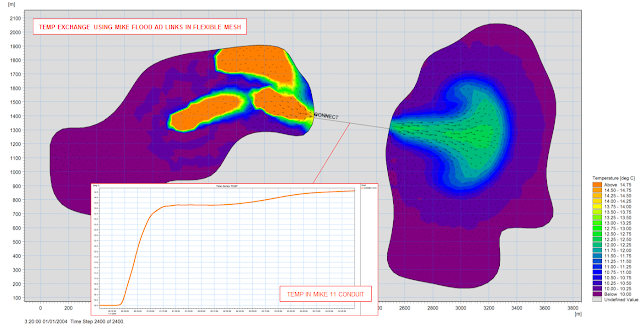
Figure: Two FM domains connect by a long culvert (MIKE 11 branch with closed cross sections), inflow far left, 3 heat sources in the upper lagoon.
The coupling between MIKE 11 and MIKE 21 Flow Model FM has been implemented for temperature, salinity, components in the Transport module (FMAD) and components in the ECOLAB module; so a coupled (MIKE FLOOD) model can allow for the full exchange of salinity, temperature and other tracers: -

Figure: Two FM domains connect by a long culvert (MIKE 11 branch with closed cross sections), inflow far left, 3 heat sources in the upper lagoon.
Monday, 4 November 2013
Previews of MIKE by DHI Release 2014
Approximately once a year, we release a new version of our MIKE by DHI software - and this year is no exception. We would like to reveal herewith a preview of some of the new and exciting features to be released later this year. We hope these new features will improve your experience with our software products, regarding usability, productivity as well as enhanced applications.
Introducing MIKE 21 GPU
If you are using MIKE 21 FM HD or Flexible Mesh solver with MIKE FLOOD, you are getting a pleasant surprise with Release 2014! With the new release, your update package will automatically include a brand new version of the MIKE 21 FM HD module. The new version, MIKE 21 GPU (Graphical Processor Units), is “GPU-card enabled”. This means that it is able to use the graphics card on your PC to speed up simulations significantly.
 Speed up you models
Depending on the model setup and the type of GPU, the speed-up can be a factor 100 or more compared to running the same simulation on a single processor CPU.
For some model setups and GPUs, this also means that MIKE 21 FM is now faster than MIKE 21 “Classic” - the single grid version of MIKE 21 HD - when using exactly the same rectangular mesh.
The technology behind MIKE 21 GPU: How does it work?
The computational engine of MIKE 21 FM HD has been reprogrammed to make use of the latest graphical processor units - hardware that is otherwise typically used for speeding up computer games.
How will I get MIKE 21 GPU?
MIKE 21 GPU will become available, at no extra cost, to all owners of corporate licences of MIKE 21 or MIKE FLOOD with valid SMA. This means that there will be no licence fee and no increase in SMA costs. If you do not have a valid SMA or if you own a personal licence, you will be able to purchase it as an upgrade to your existing software.
Where can I read more about MIKE 21 GPU?
We have produced a detailed performance report, including comparisons of the performance of MIKE 21 GPU with the non-GPU enabled MIKE 21 FM HD. Click here to read the report.
For more information about MIKE 21 GPU, check out future issues of this new newsletter or contact our software support team.
Introducing exciting new possibilities in MIKE Animator Plus
Version 2012 of MIKE by DHI included a completely re-engineered version of MIKE Animator, designed to be a very flexible tool for producing high quality video animations of modelling results. The most prominent new features in version 2012 were the support of MIKE 3 files (including the ability to slice and take out transects and iso-surfaces) and also improved picture draping functionality.
We have continued the development of MIKE Animator Plus and version 2014 will contain three new and interesting possibilities:
 Visualisation of solids: Enhancing realism and recognition of locations
The inclusion of solids can improve the animations significantly through enhancing realism and recognition of locations, for example by including fixed elements like buildings or dams or moving elements like ships. Version 2014 will support the placement of solids inside the model domain. These elements have to be created in 3DS format and then loaded into MIKE Animator Plus. Moreover, they can move inside the animation, which means that a ship can be sailing as part of the animation.
Visualisation of particles: Enhancing result communication
Output files with particle trajectories from the Particle Tracking (PT) modules (MIKE 21 PT and MIKE 3 PT) and from the Agent Based Modelling (ABM) modules (ABM for MIKE 21 and MIKE 3) will now be supported in MIKE Animator Plus. This will enhance the possibilities for result communication from these modules significantly. Click here to view an example.
Support of MIKE SHE files: High quality animations of MIKE SHE results
Also, output from MIKE SHE will now be supported in MIKE Animator Plus in order to allow for high quality animations of MIKE SHE results. This will include animation of overland flow as well as 3D groundwater flow.
New water quality option in MIKE HYDRO Basin
MIKE HYDRO Basin is our new generation of integrated river basin analysis software for water recourses planning and management.
MIKE HYDRO Basin was initially introduced with the current release 2012 containing a large number of features relevant for integrated river basin management applications. Developments continue for MIKE HYDRO Basin and one of the new exiting features being introduced in release 2014 is the option of applying water quality simulations within your river basin management applications.
Water quality options in the basin management software package have traditionally been limited to a few hard-coded water quality formulations. However, the new release will include a major upgrade in that respect, as water quality modelling in MIKE HYDRO Basin will be using the open and very flexible ECO Lab modelling framework. This will allow you to alter existing water quality templates or create your own model templates from scratch. Therefore, the ECO Lab option will greatly enhance the options for applying tailored water quality modelling for your particular water resources management or planning project.
Approximately once a year, we release a new version of our MIKE by DHI software - and this year is no exception. We would like to reveal herewith a preview of some of the new and exciting features to be released later this year. We hope these new features will improve your experience with our software products, regarding usability, productivity as well as enhanced applications.
Introducing MIKE 21 GPU
If you are using MIKE 21 FM HD or Flexible Mesh solver with MIKE FLOOD, you are getting a pleasant surprise with Release 2014! With the new release, your update package will automatically include a brand new version of the MIKE 21 FM HD module. The new version, MIKE 21 GPU (Graphical Processor Units), is “GPU-card enabled”. This means that it is able to use the graphics card on your PC to speed up simulations significantly.
Depending on the model setup and the type of GPU, the speed-up can be a factor 100 or more compared to running the same simulation on a single processor CPU.
For some model setups and GPUs, this also means that MIKE 21 FM is now faster than MIKE 21 “Classic” - the single grid version of MIKE 21 HD - when using exactly the same rectangular mesh.
The technology behind MIKE 21 GPU: How does it work?
The computational engine of MIKE 21 FM HD has been reprogrammed to make use of the latest graphical processor units - hardware that is otherwise typically used for speeding up computer games.
How will I get MIKE 21 GPU?
MIKE 21 GPU will become available, at no extra cost, to all owners of corporate licences of MIKE 21 or MIKE FLOOD with valid SMA. This means that there will be no licence fee and no increase in SMA costs. If you do not have a valid SMA or if you own a personal licence, you will be able to purchase it as an upgrade to your existing software.
Where can I read more about MIKE 21 GPU?
We have produced a detailed performance report, including comparisons of the performance of MIKE 21 GPU with the non-GPU enabled MIKE 21 FM HD. Click here to read the report.
For more information about MIKE 21 GPU, check out future issues of this new newsletter or contact our software support team.
Introducing exciting new possibilities in MIKE Animator Plus
Version 2012 of MIKE by DHI included a completely re-engineered version of MIKE Animator, designed to be a very flexible tool for producing high quality video animations of modelling results. The most prominent new features in version 2012 were the support of MIKE 3 files (including the ability to slice and take out transects and iso-surfaces) and also improved picture draping functionality.
We have continued the development of MIKE Animator Plus and version 2014 will contain three new and interesting possibilities:
The inclusion of solids can improve the animations significantly through enhancing realism and recognition of locations, for example by including fixed elements like buildings or dams or moving elements like ships. Version 2014 will support the placement of solids inside the model domain. These elements have to be created in 3DS format and then loaded into MIKE Animator Plus. Moreover, they can move inside the animation, which means that a ship can be sailing as part of the animation.
Visualisation of particles: Enhancing result communication
Output files with particle trajectories from the Particle Tracking (PT) modules (MIKE 21 PT and MIKE 3 PT) and from the Agent Based Modelling (ABM) modules (ABM for MIKE 21 and MIKE 3) will now be supported in MIKE Animator Plus. This will enhance the possibilities for result communication from these modules significantly. Click here to view an example.
Support of MIKE SHE files: High quality animations of MIKE SHE results
Also, output from MIKE SHE will now be supported in MIKE Animator Plus in order to allow for high quality animations of MIKE SHE results. This will include animation of overland flow as well as 3D groundwater flow.
New water quality option in MIKE HYDRO Basin
MIKE HYDRO Basin is our new generation of integrated river basin analysis software for water recourses planning and management.
MIKE HYDRO Basin was initially introduced with the current release 2012 containing a large number of features relevant for integrated river basin management applications. Developments continue for MIKE HYDRO Basin and one of the new exiting features being introduced in release 2014 is the option of applying water quality simulations within your river basin management applications.
Water quality options in the basin management software package have traditionally been limited to a few hard-coded water quality formulations. However, the new release will include a major upgrade in that respect, as water quality modelling in MIKE HYDRO Basin will be using the open and very flexible ECO Lab modelling framework. This will allow you to alter existing water quality templates or create your own model templates from scratch. Therefore, the ECO Lab option will greatly enhance the options for applying tailored water quality modelling for your particular water resources management or planning project.
It's been more than a little quiet on the blog of late - sincere apologies for this - but you can expect a flurry of activity very soon!
 Steve - 04/11/13
Thursday, 1 August 2013
MIKE by DHI 2012 Hot Fixes
 Just a reminder that, as with Service Packs, Hot Fixes are now available on our external website. We would recommend that you are up to date with the relevant fixes (both service packs and hot fixes), or at least are aware of them.
Hot fixes are generated between service packs and usually fix critical issues that can’t wait for the next service pack or major release.
To visit the Hot Fixes webpage please click below: -
Hot fixes are generated between service packs and usually fix critical issues that can’t wait for the next service pack or major release.
To visit the Hot Fixes webpage please click below: -
Local Area Weather Radar for Urban Hydrology
Climate change can be expected to affect prevailing patterns of precipitation with extreme rain events becoming more frequent and more intense. This will increase the pressure on water collection systems and wastewater treatment plants. Warning and forecasting systems provide necessary tools for authorities and operators to plan ahead and make the right decisions. Accurate predictions can be made if sufficient data are available. However, the greatest uncertainty when modelling the response of drainage systems to rainfall is the rainfall itself.
The standard approach is to use rainfall measured by one gauge but traditional rain gauges provide data with low temporal and spatial resolution. When using rain gauges, it must be assumed that the rainfall is homogenous over the whole model area, which may be as large as a whole city. For the prediction of potential surface water flooding as a result of extreme rain events, this assumption is not valid.
Weather radars, in contrast to rain gauges, provide high resolution data over a relatively large area, the equivalent of many synthetic rain gauges in one installation. However, dedicated weather radars are expensive. Local Area Weather Radar (LAWR), developed by DHI from modified marine radar and using interpretation algorithms, can provide high resolution rainfall data at a much lower cost. Such systems are already installed in many cities worldwide. They detect the first raindrop falling and track the precipitation as it falls. This provides accurate rainfall data with high spatial resolution, which is suitable for input to flood warning and forecast models.
LAWR Advantages and Integration

The image above shows a rain event imported into MIKE URBAN. It illustrates a classical problem - only part of the drainage system is receiving rain. If a user wants to analyse such an event based on a single gauge several kilometres away it would yield a very poor result. LAWR data provides the user with a whole range of new opportunities. It is possible to see the event move and evolve over the drainage system, and see which catchments receive the heavy intensities.
Climate change can be expected to affect prevailing patterns of precipitation with extreme rain events becoming more frequent and more intense. This will increase the pressure on water collection systems and wastewater treatment plants. Warning and forecasting systems provide necessary tools for authorities and operators to plan ahead and make the right decisions. Accurate predictions can be made if sufficient data are available. However, the greatest uncertainty when modelling the response of drainage systems to rainfall is the rainfall itself.
The standard approach is to use rainfall measured by one gauge but traditional rain gauges provide data with low temporal and spatial resolution. When using rain gauges, it must be assumed that the rainfall is homogenous over the whole model area, which may be as large as a whole city. For the prediction of potential surface water flooding as a result of extreme rain events, this assumption is not valid.
Weather radars, in contrast to rain gauges, provide high resolution data over a relatively large area, the equivalent of many synthetic rain gauges in one installation. However, dedicated weather radars are expensive. Local Area Weather Radar (LAWR), developed by DHI from modified marine radar and using interpretation algorithms, can provide high resolution rainfall data at a much lower cost. Such systems are already installed in many cities worldwide. They detect the first raindrop falling and track the precipitation as it falls. This provides accurate rainfall data with high spatial resolution, which is suitable for input to flood warning and forecast models.
LAWR Advantages and Integration
- Distributed rainfall measurements in a spatial resolution ranging from 500x500 m to 100x100 m with a 5 minute or 1 minute time resolution up to 30 km from the radar
- Online animation of rainfall within the complete LAWR range
- Up to a few hours' forecast (online) of coming rain events for use in optimisation of sewer and treatment plant capacity
- Fully integrated with MIKE URBAN (from release 2007) which facilitates the import of LAWR data, visualisation of the event over the model and its catchments and simulation with fully distributed rainfall
- LAWR data is supported by the full MIKE by DHI software suite

The image above shows a rain event imported into MIKE URBAN. It illustrates a classical problem - only part of the drainage system is receiving rain. If a user wants to analyse such an event based on a single gauge several kilometres away it would yield a very poor result. LAWR data provides the user with a whole range of new opportunities. It is possible to see the event move and evolve over the drainage system, and see which catchments receive the heavy intensities.
Subscribe to:
Posts
(Atom)
Follow DHI...


